
Quick Facts
- Common Names: Platy, Southern platyfish, Moon platy, Wag platy, Mickey Mouse platy, Sunset platy
- Scientific Name: Xiphophorus maculatus (common platy); Xiphophorus variatus (variatus platy)
- Adult Size: 1-3 inches total length; males smaller (~3-5 cm), females larger (up to 6-8 cm)
- Lifespan: 3-4 years in captivity with good care
- Care Level: Beginner – Very tolerant and highly adaptable
- Temperament: Peaceful community fish
- Diet: Omnivore
- Minimum Tank Size: 10 gallons for small group; 20 gallons recommended
- Recommended Tank Size: 20-40 gallons for active schools and breeding
- Temperature Range: 72-82°F (22-28°C); Optimal: 76-78°F (24-25°C)
- pH Range: 6.8-8.5 tolerant; Optimal: 7.0-8.0 (slightly alkaline)
- Water Hardness: 10-28 dGH (hard water preferred)
- Breeding Difficulty: Very Easy – Prolific livebearers
- Breeding Method: Livebearer – internal fertilization with live fry births
- Native Range: Central America: Mexico, Guatemala, Belize
Introduction
Platies are the bread-and-butter fish of the beginner aquarium hobby. If guppies are the gateway drug, platies are the comfortable favorite you keep coming back to. These peaceful, colorful livebearers come in an astounding variety of patterns and colors-from solid reds and blacks to Mickey Mouse tails, sunset patterns, and dalmatian spots. They’re easy to care for, breed prolifically without any special effort, get along with almost everything, and thrive in the moderately hard, slightly alkaline water that comes straight from many home taps. Whether you’re setting up your first tank or adding reliable community members to an established setup, platies deliver.
Video Overview
Appearance
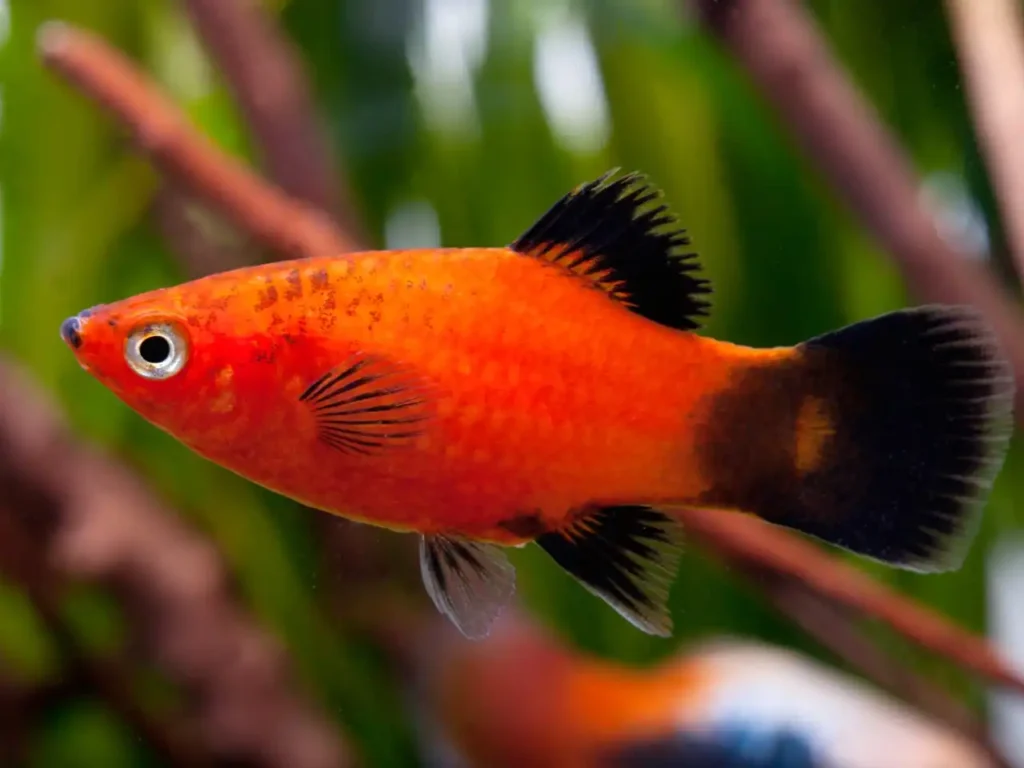
Platies are compact, colorful fish that look like smaller cousins of swordtails. What makes them special is the incredible variety of colors and patterns available through selective breeding.
Body Structure: Platies have a short, rounded body with a slight lateral compression (flattened side-to-side). They’re noticeably shorter and rounder than guppies or swordtails. Males are smaller and more slender, while females are larger and deeper-bodied, particularly when carrying eggs. The small, upturned mouth indicates their natural feeding preference for surface and midwater food sources.
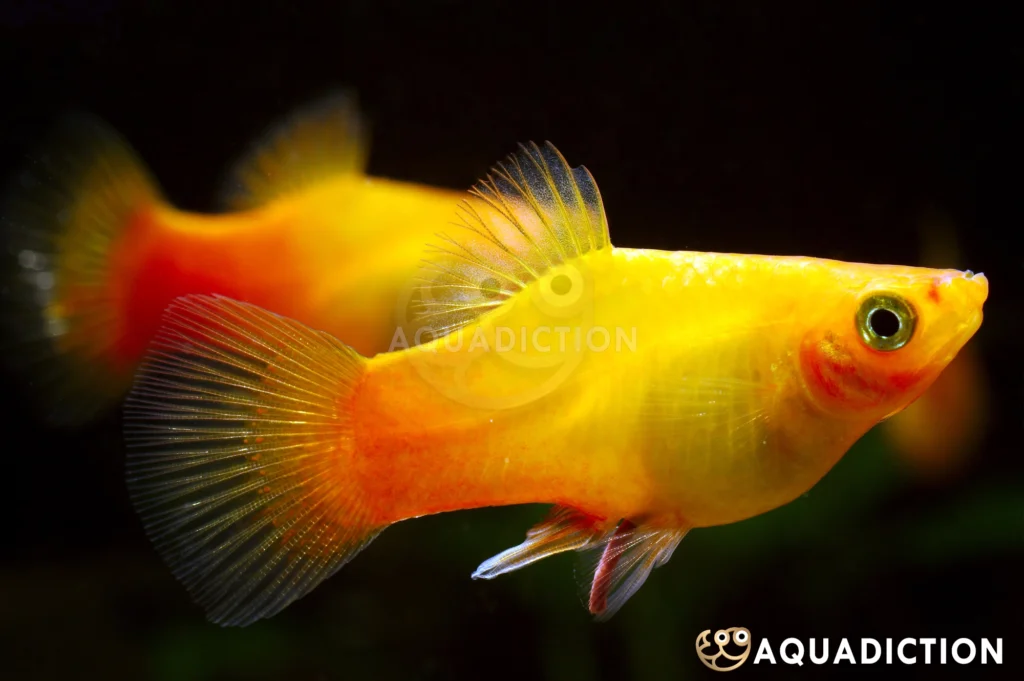
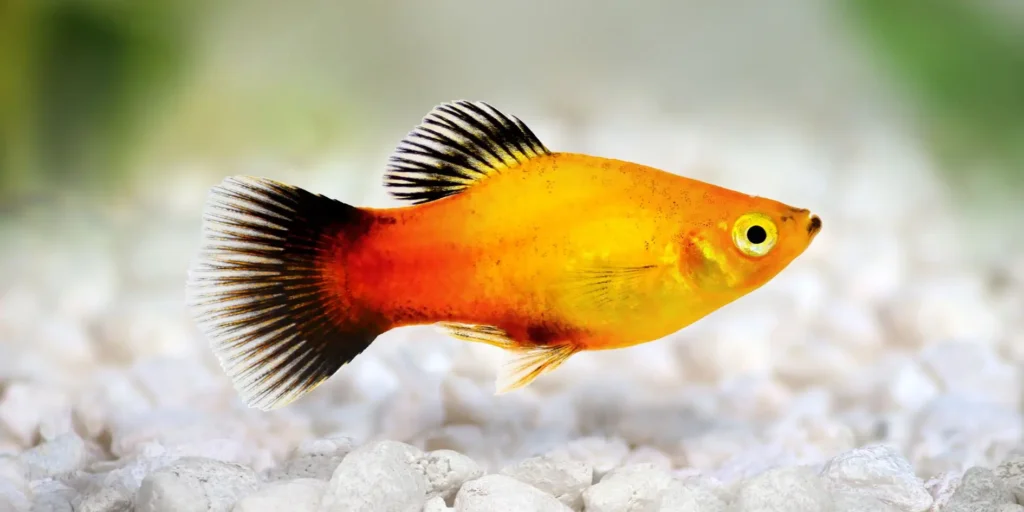
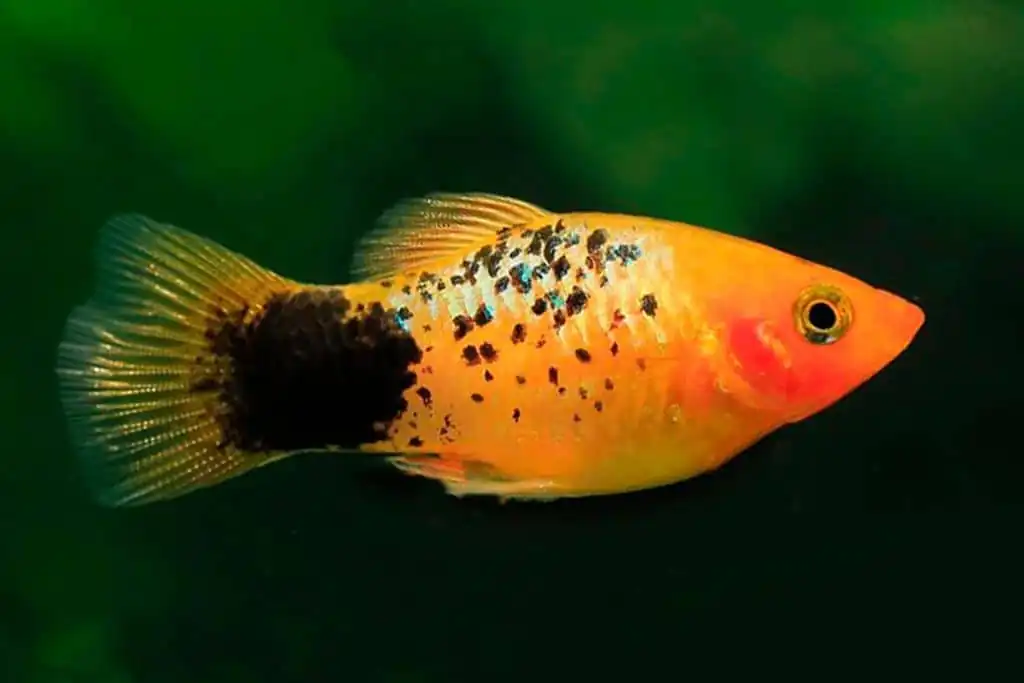
Coloration: The range is extraordinary. Wild-type platies are red with black markings, but selective breeding has created an endless palette: solid red, yellow, white, black, orange, calico patterns, dalmatian spots, tuxedo/wag patterns (black and white), sunset/sunburst patterns, Mickey Mouse tail markings (the tail looks like Mickey Mouse’s face), and hi-fin varieties with enlarged dorsal fins. Some strains combine multiple patterns-a Mickey Mouse tail with sunset coloration, for example. The variety rivals guppies, giving you almost unlimited aesthetic options.
Sexual Dimorphism: Males have a gonopodium (a rod-like modified anal fin used for reproduction), while females have a normal fan-shaped anal fin. Females are noticeably larger and rounder than males. When pregnant, females develop a gravid spot (dark area near the anal fin) and appear significantly plumper. Gender identification is straightforward from juvenile stages forward.
Key trait: Unlike guppies with elaborate flowing tails, platies have more rounded, fan-shaped tails. Some hi-fin strains have enlarged dorsal fins that require gentle water flow. The combination of patterns and body shapes within the Xiphophorus genus creates endless visual variety.
Creating the Right Environment
Platies are adaptable and forgiving, but they thrive in planted community tanks designed to reduce stress and showcase their colors.
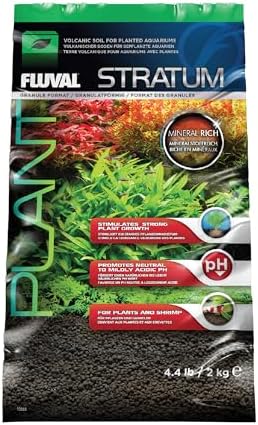
Dark Substrate Enhances Appearance: Use fine black, dark brown, or dark gray sand or small gravel. Against this background, platy colors appear more vibrant and saturated. The visual contrast helps reds appear deeper, yellows brighter, and patterns more distinct. Dark substrates also reduce stress by providing visual security and mimicking their natural forest stream habitat.
Heavily Planted Tank with Open Areas: Platies appreciate plants for security and hiding spots, especially females avoiding male harassment and protecting fry. Use tall stem plants (Amazon Sword, Ludwigia), broad-leafed plants (Anubias, Java Fern), and floating plants (water lettuce, duckweed, frogbit). Floating plants are particularly useful for providing overhead cover and creating refuge for females and fry. Balance dense perimeter planting with open central swimming areas where they can explore and school naturally.
Driftwood and Hardscape for Territory Breaking: Strategic placement of driftwood, rocks, and artificial caves creates line-of-sight breaks. This is particularly important in all-female or male-heavy populations, as it significantly reduces male-on-male competition and male harassment of females. Breaking up the visual landscape allows territories to be established without constant confrontation.
Gentle to Moderate Water Flow: Platies prefer calm to moderate water flow. Hi-fin varieties especially benefit from gentle circulation that allows their enlarged dorsal fins to move gracefully without being pushed around by strong currents. Sponge filters provide ideal gentle circulation.
Moderate to Bright Lighting: Unlike blackwater species, platies tolerate and appreciate brighter lighting (20-40 lumens per liter). Moderate to bright lighting highlights their colors without causing stress. Cool white (6500K) emphasizes blues and metallics, while warm white (3000K-4000K) brings out reds and oranges. Full-spectrum provides balanced color rendering.
Care Basics
Water: Platies prefer warm, hard, slightly alkaline water. Maintain 76-78°F, pH 7.0-8.0, and 10-28 dGH (hard water). They’re remarkably adaptable-they can survive in pH 6.8-8.5 and temperatures 72-82°F-but they thrive in these optimal ranges. Many aquarists appreciate platies because they thrive in moderately hard tap water that comes straight from the faucet, without requiring adjustment.
Tank Size: Start with 10 gallons minimum for a small group of 5-6 platies, but 20 gallons is strongly recommended for community setups and breeding. Larger tanks provide better water stability and allow for natural schooling behavior. Calculate approximately 2-3 gallons per fish as a safe minimum.
Food: Platies are omnivores needing variety. Use high-quality flakes or micro pellets as your staple. Supplement regularly with frozen foods: baby brine shrimp, daphnia, bloodworms, mosquito larvae. Live foods (newly hatched brine shrimp, microworms) are excellent for conditioning breeding stock. Feed once or twice daily in portions they finish in 2-3 minutes. Remove uneaten food immediately to maintain water quality.
Equipment: You’ll need a reliable heater (50-100 watts depending on tank size) to maintain consistent 76-78°F. A sponge filter or gentle hang-on-back filter works perfectly for platies-they prefer calm water. Flow should be 2-4 times your tank volume per hour. A tight-fitting lid is recommended to prevent accidental jumps and reduce evaporation. Test kit for ammonia, nitrite, nitrate, pH, and hardness is essential for monitoring.
Maintenance: Perform 25-30% water changes weekly in established community tanks. In breeding tanks with high bioload, increase frequency to 25-50% twice weekly. Never allow more than 4 weeks between water changes. Always match replacement water temperature to tank water (within 1-2°F). Test ammonia and nitrite weekly-they must stay at 0 ppm. Keep nitrates below 30-40 ppm for optimal health.
Behavior
Platies are active, peaceful, social fish that provide constant entertainment throughout the day. They’re curious and bold, readily investigating new decorations and eagerly approaching feeding time.
What to Expect: In established tanks with good group sizes, platies are confident explorers. They swim throughout all water levels-surface, midwater, and substrate-constantly foraging and investigating. They’re active mid-to-surface swimmers, often hanging near the top during feeding. They display beautiful schooling behavior, moving together while still maintaining individual personalities.
Personality: Platies are peaceful and social. They get along with almost everything, rarely showing aggression toward other species. Males show some dominance displays toward each other (chasing, fin spreading), but these are rarely injurious. The key is maintaining proper female-to-male ratio. Males court females constantly, which is normal mating behavior but can stress females if ratios aren’t balanced.
Activity Patterns: Most active during morning and evening hours, with particular activity peaks at dusk and dawn. They’re nearly always moving-foraging in plants, exploring the tank, investigating new objects. They’re more active than many community fish, which makes them entertaining to watch.
Male Aggression: In male-heavy populations, expect chasing and jostling. This is usually harmless but can stress females. The solution is simple: maintain 2-3 females per male. With proper ratios, male attention is diffused and females are less harassed. In breeding setups, this ratio dramatically increases fry production by reducing female stress.
Tank Mates
Platies are peaceful community fish perfect for multi-species tanks. They’re compatible with almost everything non-aggressive.
Good Choices:
- Small tetras: Neon tetras, Cardinal tetras, Ember tetras, Black Skirt tetras. Share peaceful temperament and work well in communities.
- Other livebearers: Guppies, Mollies, Endlers. Compatible water conditions and breeding patterns.
- Small rasboras: Harlequin rasboras, Chili rasboras. Compatible in size and temperament.
- Corydoras catfish: Bronze, Pygmy, Panda corydoras. Occupy bottom layer; peaceful and compatible.
- Otocinclus catfish: Small, peaceful bottom-dwellers. Keep in groups of 2-3.
- Small plecos: Bristlenose plecos help control algae.
- Peaceful gouramis: Honey gouramis, Sparkling gouramis. Compatible in size and temperament.
- Small rainbowfish: Boesemani rainbows, Dwarf rainbows. Compatible in water preferences.
- Peaceful barbs: Cherry barbs, some Gold barbs. Compatible but watch for feeding speed-use multiple feeding points.
- Freshwater shrimp: Cherry shrimp in heavily planted tanks with dense cover.
- Snails: Mystery snails, Nerite snails. Peaceful and occupy different ecological niches.
Be Careful With:
- Male bettas: Highly variable results. Can work in heavily planted 20+ gallon tanks, but betta temperament varies.
- Fin-nippy barbs: Tiger barbs, some other aggressive barbs. Can harass platies.
- Dwarf gouramis: Can become aggressive during breeding.
- Fast feeders: Larger livebearers or aggressive feeders may outcompete platies.
Avoid Completely:
- Large cichlids: Oscars, Jacks, Greens. Too aggressive.
- Adult angelfish: Will predate on platies.
- Predatory fish: Arowanas, piranhas, large catfish.
- Pufferfish: Aggressive fin-nippers.
- Goldfish: Completely different temperature needs.
- Blackwater species: Prefer soft, acidic water opposite to platies’ needs.
Community Tank Notes: Provide space (20g+), plants, and multiple feeding points to prevent competition and reduce stress. Platies are peaceful, but they still need adequate resources.
Common Health Issues
Platies are hardy and less disease-prone than many tropical fish, but three issues are most common.
Ich (White Spot Disease): A parasitic infection causing tiny white spots on body, fins, and gills. Prevention is straightforward: quarantine new fish for 2-4 weeks, maintain stable temperature (76-78°F), reduce stress through proper group size and hiding spots, and maintain excellent water quality (0 ammonia/nitrite). Treat by gradually raising temperature to 80-82°F, using ich medication per label instructions, and performing 25% daily water changes. Remove activated carbon during treatment as it absorbs medication. Treatment takes 7-10 days minimum.
Fin Rot / Bacterial Infections: Frayed, deteriorating fin edges with white, red, or black discoloration. Often a secondary infection following stress or poor water quality. Prevention: maintain excellent water quality with regular water changes (25% weekly), avoid overcrowding, remove sharp decorations, and quarantine new arrivals. Treat with antibiotic medications (Erythromycin or Furan-2) according to package instructions. Perform 50% water change, increase aeration, and address the root cause (poor water quality, stress, or fin damage from tank mates).
Columnaris and Internal Parasites: Crowded or stressed fish from pet stores may introduce these problems. Prevention through strict quarantine (2-4 weeks) is the best approach. Watch for clamped fins, loss of appetite, white patches, and lethargy. Treat with appropriate antibiotics if columnaris is suspected. Internal parasites may require medicated foods or specific parasite treatments.
Quarantine: Always isolate new platies for 2-4 weeks before introducing to main tank. Watch for ich (white spots), fin damage, fading color, wasting, abnormal swimming, and lesions. Feed high-quality varied diet during quarantine to boost immune system.
Lighting & Appearance
Light spectrum, intensity, and photoperiod directly affect how your platies look and behave.
Light Spectrum: Warm white (3000K-4000K) emphasizes reds, oranges, and yellows, making warm-colored patterns more vivid. Cool white (6500K-7000K) makes blues and metallics glow vibrant. Full-spectrum (5000K-6500K) provides balanced color rendering for both warm and cool colors. Experiment with different spectrums to find what appeals to you-warm white for solid red platies, cool white for calico or dalmatian patterns.
Light Intensity: Moderate to bright (20-40 lumens per liter). Platies tolerate bright lighting much better than many tropical fish and appreciate good lighting that highlights their colors. Bright lighting stimulates natural activity and supports plant growth if using a planted tank.
Photoperiod: 8-10 hours daily for most setups maintains biological rhythm and minimizes algae growth. Use automatic timers for consistency. You can extend to 10-12 hours to stimulate breeding activity, but this increases algae risk.
Dark Backgrounds and Substrate: A dark background (black or deep blue) combined with dark substrate makes platy colors pop dramatically. The contrast between their vibrant coloration and dark background is stunning. Light substrates wash out colors and reduce visual impact.
Dimmer Light Benefits: Floating plants that dapple light reduce stress for females and fry. The more comfortable females are, the better they thrive and produce fry.
Breeding
Platies are extremely easy to breed, making them perfect for beginners interested in reproduction.
Breeding Method: Platies are livebearers, meaning females give live birth rather than laying eggs. Eggs are fertilized internally and develop inside the female’s body with a placenta-like connection. Fry are born fully-formed and ready to feed immediately.
Breeding Frequency: With adequate nutrition and males present, females produce live fry approximately every 28-35 days after reaching maturity. Females store sperm and can produce multiple batches of fry from a single mating; fry production continues for months after male separation.
Spawning Triggers: Platies breed readily with minimal conditions:
- Hard, slightly alkaline water (7.0-8.0, 10-28 dGH)
- Stable warmth (76-78°F)
- Quality feeding (live/frozen foods condition females)
- Adequate females (2-3 per male reduces stress)
- Large water changes (25-50%) often trigger spawning
Expected Outcomes:
- Fry per Birth: 10-40 average (smaller than guppies but larger than many fish)
- Birth Duration: 1-2 hours typically (faster than guppies)
- Fry Size: Born 0.3-0.5 inches, fully-formed and ready to feed
- Growth Rate: Reach 0.5 inch in 2-3 weeks
- Sexual Maturity: 6-8 weeks; males develop color and gonopodium
- Fry Feeding: Can eat crushed flakes or powdered fry food immediately; accept baby brine shrimp by day 2-3
- Feeding Schedule: 3-4 small meals daily initially; reduce to 2-3 times daily by 4 weeks
- Survival Rate (Community Tank): 5-20% (most consumed by parents)
- Survival Rate (Managed): 50-80% in planted setups with frequent feeding
Natural Breeding (Community Tank): Simply keep males and females together. Females will give birth in dense vegetation. Most fry are consumed by adults, but some survive in heavily planted setups.
Intentional Breeding (For Maximum Fry Survival):
- Tank Size: 10-20 gallon breeding tank
- Stocking: 1-2 males with 3-5 females (females produce more fry than males impregnate them)
- Substrate: Fine sand or planted bottom
- Plants: Dense Java moss, floating plants for fry refuge
- Filtration: Gentle sponge filter
- Water Conditions: pH 7.0-8.0, hard water (12+ dGH), temperature 76-78°F
- Water Changes: 25-30% weekly; 50% changes stimulate spawning
Population Control: Platies breed readily. You’ll either need to cull unwanted fry, distribute to other aquarists, or keep only females. It’s a good problem to have-it means your care is excellent.
FAQ
Q: What size tank do platies need?
A: At least 10 gallons for a small group of 5-6 platies. However, 20 gallons or larger is strongly recommended for communities and breeding. Larger tanks provide better water stability and allow for natural schooling and reduced stress.
Q: Are platies good for beginners?
A: Yes, absolutely. Platies are among the best beginner fish due to extreme hardiness, peaceful temperament, adaptability to a broad range of water parameters, and prolific breeding without special conditions. They tolerate beginner mistakes well and require only basic equipment.
Q: How many platies should be kept together?
A: Keep at least 5-6 platies for natural behavior and reduced stress. The key is maintaining 2-3 females per male to minimize male harassment. Unbalanced ratios cause excessive chasing and stress, shortening female lifespan.
Q: What water parameters do platies prefer?
A: Platies prefer 72-82°F temperature, pH 7.0-8.0 (slightly alkaline), and hard water 10-28 dGH. They tolerate pH 6.8-8.5 and are remarkably adaptable to various conditions. They thrive better in hard water than most tropical fish, making them ideal for areas with hard tap water.
Q: Will platies eat their fry?
A: Yes, platies consume their own fry readily if given the opportunity. To protect fry, provide dense plants (Java moss, floating plants) where they can hide, or use a separate breeding tank or breeding box. Without protection, most fry are consumed by adults within days.
Q: What do platies eat?
A: Platies are omnivores eating high-quality flakes or micro pellets as staple, supplemented regularly with frozen or live foods like baby brine shrimp, daphnia, and bloodworms. Feed 1-2 times daily in portions they finish in 2-3 minutes. Variety supports complete nutrition and vibrant coloration.
Conclusion
Platies are the reliable workhorse of the beginner aquarium hobby. They’re not flashy like fancy guppies or dramatic like bettas, but they deliver consistent, dependable results. Hardy, peaceful, colorful, prolific breeders, and adaptable to a wide range of conditions-platies check every box for someone starting out. Whether you’re setting up your first tank or adding reliable community members to an established setup, platies thrive with minimal fuss. Their adaptability to moderately hard, slightly alkaline tap water makes them particularly valuable for aquarists in areas where water chemistry is less flexible. Set them up right-warm, hard, slightly alkaline water; adequate group size with proper male-female ratio; plants for security and fry refuge; and regular maintenance-and they’ll reward you with years of low-stress, colorful, breeding-focused activity. Once you keep platies, you’ll understand why they’ve remained one of the most popular beginner fish for decades.
Recommended Products


Related Guides
- Guppy Care Guide: Similar livebearer with comparable care but prefers softer water; good comparison for livebearer differences.
- Molly Care Guide: Another livebearer with similar breeding patterns; slightly larger and prefers brackish conditions.
- Endler’s Livebearer Care Guide: Smaller livebearer closely related to guppies; may interbreed with guppies.
- Beginner Planted Tank Setup: Step-by-step guide for creating the planted tank platies thrive in.
- Community Tank Setup for Beginners: How to build a balanced community tank with platies and compatible species.