
Part of the Complete Cichlid Aquarium Guide
Keeping plants alive with cichlids feels like gardening in a hurricane. Between constant digging, rearranging, and selective nibbling, most aquatic plants don’t stand a chance. But with the right species and planting techniques, you can create a thriving planted cichlid tank-especially with South American cichlids like Rams and Angelfish that respect vegetation.
This guide covers the plants that actually survive cichlid aggression, plus proven strategies for attaching and protecting them so your cichlids can’t destroy your scape.
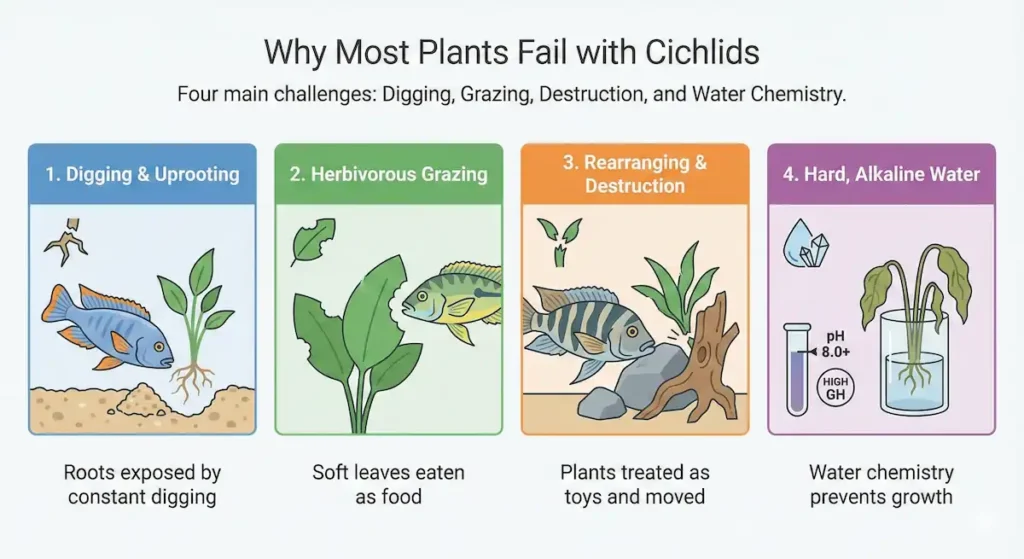
Why Most Plants Fail with Cichlids
Understanding why plants struggle in cichlid tanks helps you choose species that overcome these specific challenges.
Digging and Uprooting
Many cichlids are compulsive excavators. They dig territories, create breeding pits, and constantly rearrange substrate looking for food. Each time a fish digs near a rooted plant, the roots get exposed, damaged, and eventually the plant starves. This happens repeatedly throughout the day-your cichlid isn’t trying to destroy the plant, it’s just being a cichlid. Species like Oscars, Convicts, and most African cichlids are notorious for turning planted tanks into bare-substrate zones within weeks.
Herbivorous Grazing
Many African cichlids, especially Mbuna (rock-dwelling species), actively eat soft plant matter. They graze on algae and soft leaves the way a cow grazes grass, shredding carpeting plants and tender stem species into mulch. Even peaceful species occasionally nip dead leaves or soft new growth, which discourages many popular aquarium plants from establishing.
Rearranging and Destruction
Large cichlids like Oscars and big Severums don’t just dig-they treat plants as toys. They push rocks, move decor, uproot driftwood, and treat anything loose as something to rearrange. A plant that survives digging might get torn apart by a fish that decides the driftwood looks better six inches to the left.
Hard, Alkaline Water
African Rift Lake cichlids require hard, alkaline water (pH 7.8-8.6, high GH). Most popular aquarium plants evolved in soft, acidic South American conditions and simply don’t thrive in hard water. Even tough species struggle when water chemistry doesn’t match their preferences. This limits your plant palette dramatically compared to soft-water planted tanks.
Which Cichlids Tolerate Live Plants?
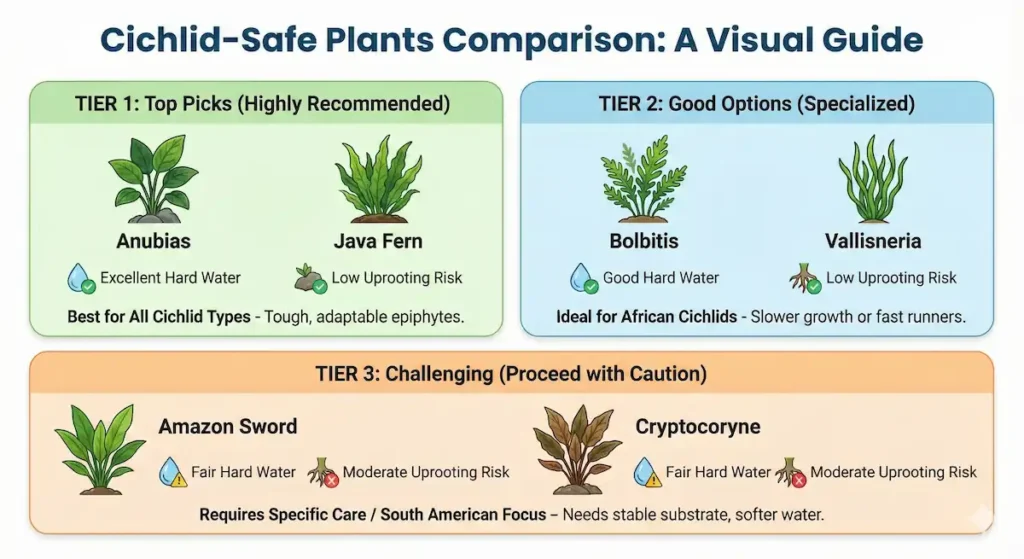
Not all cichlids are equally destructive. Your success with plants depends heavily on which cichlid species you keep.
South American Cichlids: Best for Plants
Dwarf cichlids like German Blue Rams, Apistogramma, and Kribensis are perfect for planted tanks. They’re small, relatively peaceful, and may sift substrate gently but don’t uproot plants aggressively. Angelfish and Discus are larger but still plant-compatible when given proper space. These species thrive in soft, acidic water that matches most aquatic plants’ preferences, so you can grow a true Amazon-style planted tank with dense vegetation, driftwood, leaf litter, and even carpeting plants.
Central American Cichlids: Mixed Results
Some Central American cichlids-like Convicts and Jack Dempseys-are destructive diggers and will tear apart soft plants. Others like Salvini are more moderate. Individual temperament varies, so expect some plant loss and focus on hardy species. Central American cichlids tolerate neutral to slightly alkaline water, giving you more plant options than African cichlids but fewer than South American species.
African Cichlids: Minimal Planting Only
African Rift Lake cichlids are the challenge. Their hard, alkaline water requirements eliminate most plants, and their constant digging plus herbivorous grazing create a harsh environment. Expect to maintain a mostly bare tank with only the toughest epiphytes (plants that attach to rocks rather than root in substrate). Heavily planted African cichlid tanks are rare because the fish and plant needs are fundamentally mismatched.
Oscars: Accept Almost Total Plant Loss
Oscars are intelligent, destructive, and treat plants as entertainment. Most aquarists either skip live plants entirely or accept that any rooted vegetation will eventually be uprooted. If you’re set on plants with Oscars, stick exclusively to heavy rock-attached species glued securely to immovable hardscape.
Best Plants for Cichlid Tanks
These plants survive cichlid aggression through hardy structure, attachment methods that prevent uprooting, or growth strategies that tolerate disruption.
Rock-Attached Plants (Epiphytes)
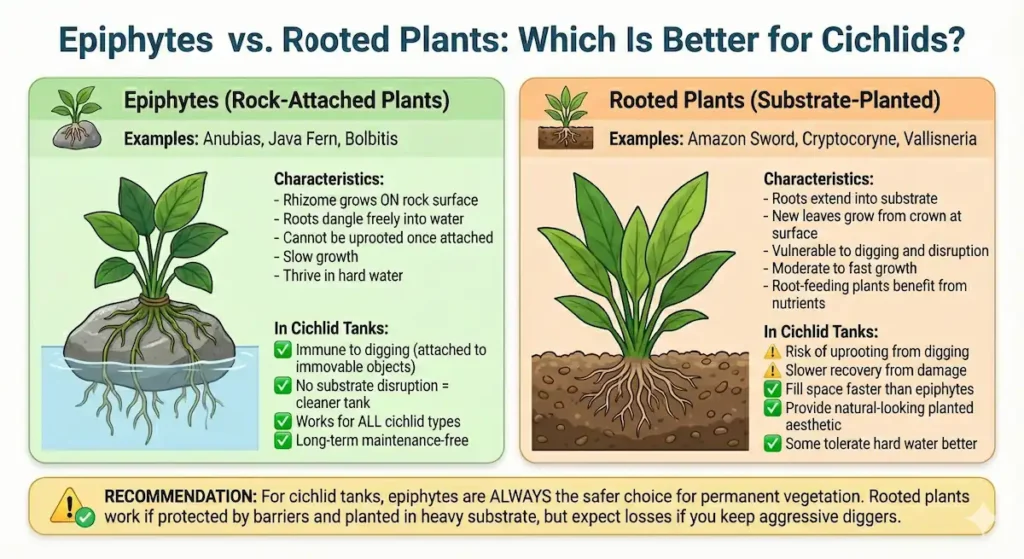
These plants naturally grow on rocks and wood in the wild, so they never root in substrate where cichlids can dig them up. Attach them properly and they’re virtually impossible to destroy.
1. Anubias (Anubias nana, barteri, coffeefolia)
Anubias is the gold standard for cichlid tanks. Its thick, leathery leaves resist nibbling, and its rhizome (the horizontal stem) naturally grows on rocks rather than in soil. The plant spreads slowly, eventually covering the rock with dense foliage that looks established and difficult to remove.
Why it works: The rhizome cannot be pulled from the substrate because it’s glued to a rock. Even aggressive digging around the rock won’t dislodge it. Anubias tolerates hard, alkaline water better than most aquatic plants and grows under low to moderate light.
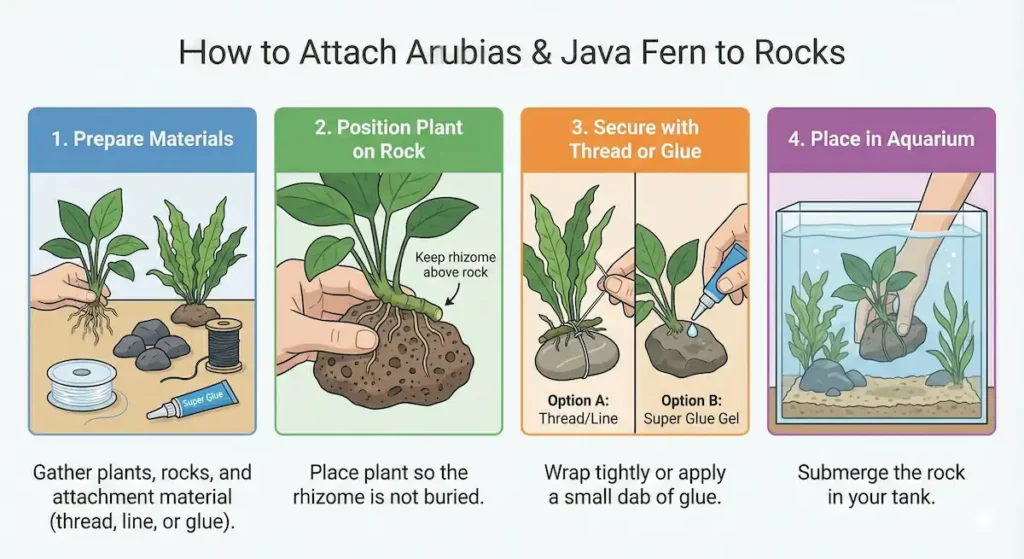
How to attach: Use plant-safe super glue gel or fishing line to tie the rhizome (not the roots) to a rock or piece of driftwood. Never bury the rhizome in substrate-this causes rot. The rhizome should sit on top of the rock, with roots dangling naturally.
Best for: All cichlid types, but especially valuable for African cichlids. Anubias nana works in small tanks, while barteri and coffeefolia create impressive focal points in larger setups.
Light: Low to moderate (2-3 hours of LED lighting is sufficient)
Water: Extremely adaptable-works in pH 5.0-8.0, hard or soft water
2. Java Fern (Microsorum pteropus and varieties)
Java fern is another rhizome plant with tougher-than-average fronds that resist damage. Multiple varieties exist: standard Java fern with broad fronds, Windelov with distinctive wavy edges, and narrow leaf for a delicate appearance. All are equally durable.
Why it works: Like Anubias, Java fern attaches to hardscape and cannot be uprooted. Its fronds are tougher than typical stem plants, so even species that nip soft plants usually leave Java fern alone.
How to attach: Tie the rhizome (where new fronds originate) to rock or driftwood. Young leaves grow upward, eventually creating a fountain-like appearance. The plant grows moderately fast compared to Anubias, filling space relatively quickly.
Best for: All cichlid types. Works especially well as a background plant in corner hardscape arrangements.
Light: Low to moderate (same as Anubias)
Water: Highly adaptable (pH 5.0-8.0)
3. Bolbitis (African Water Fern)
Bolbitis heudelotii looks delicate with its feathery fronds, but it’s surprisingly tough. It’s another rhizome fern, so it attaches to hardscape and resists uprooting. Many aquarists overlook it for cichlid tanks because it looks fragile, but experienced keepers know it’s one of the most reliable planted tank companions for African cichlids.
Why it works: The rhizome attaches firmly to rock or wood. Fronds are resilient despite their appearance. Bolbitis tolerates harder, more alkaline water than most ferns, making it ideal for African cichlid tanks.
How to attach: Tie the rhizome to hardscape the same way as Anubias and Java fern. Bolbitis grows more slowly than Java fern but eventually creates dense, beautiful foliage.
Best for: African cichlid tanks where you want to maximize plant coverage. The delicate fronds create visual contrast against rocks.
Light: Low to moderate
Water: Tolerates pH 6.0-7.5 and moderate hardness better than most ferns
Rooted Plants That Survive Cichlids
These plants root in substrate but develop deep root systems or sturdy leaves that help them recover from disruption.
4. Vallisneria (Spiral Vallis, straight Vallis)
Vallisneria is one of the few rooted plants naturally found in hard, alkaline environments like African Rift Lakes. It grows in long, grass-like ribbons from a central rosette, creating a feathery background effect. It tolerates digging surprisingly well because its roots go extremely deep.
Why it works: Vallisneria’s root system is tough and extensive, so occasional uprooting doesn’t kill it. The long leaf structure also means the plant occupies vertical space rather than bottom space, reducing direct contact with digging fish. It grows rapidly, quickly replacing any leaves that get damaged or grazed.
How to plant: Plant the plant crown (where leaves meet roots) at or just above substrate level. Let roots extend down naturally. Don’t plant too deep or the crown will rot.
Best for: African cichlid tanks where you want the benefits of live plants despite challenging conditions. Works well for Central American cichlids too.
Light: Moderate to high
Water: Extremely hard-water tolerant (pH 7.5-8.6, high GH)
5. Amazon Sword (Echinodorus species)
Amazon swords are large, impressive plants with broad, tough leaves. Once established, they develop extensive root systems and can recover from occasional damage. They’re slower than Vallisneria but provide more visual impact.
Why it works: Heavy root feeders with deep, spreading root systems make them resilient to disruption. Established plants have leaves tough enough to resist casual nibbling. The broad leaves also provide shade and territory markers that cichlids appreciate.
How to plant: Plant the crown just above substrate. Use root tabs or nutrient-rich substrate to support growth. Bury the root mass but keep the crown exposed.
Best for: South American cichlid tanks where soft water allows optimal growth. Works with gentle Central American species.
Light: Moderate to high (benefits from LED supplementation)
Water: Prefers soft to neutral water (pH 6.0-7.5)
6. Cryptocoryne (various species)
Crypts are slow-growing plants with deep roots and tough leaves. Larger species like C. wendtii tolerate hard water and develop substantial root systems. After an initial adjustment period, established plants are difficult to dislodge completely.
Why it works: Deep roots anchor the plant firmly. Leaves are relatively tough. Once mature, Crypts recover quickly from disturbance. Different species handle various water chemistry ranges.
How to plant: Plant the crown at substrate level. Expect 2-4 weeks of “crypt melt” where leaves dissolve-this is normal. Eventually new leaves emerge from the root mass and growth accelerates.
Best for: Any cichlid setup. C. wendtii handles harder water while C. parva stays small for compact tanks.
Light: Low to moderate (tolerates shade well)
Water: Species-dependent, but larger forms tolerate pH 6.5-8.0
Floating Plants
Floating plants sidestep digging entirely because they never root in substrate. They provide shade, consume excess nutrients (important with large cichlid bioloads), and grow fast enough to replace damage.
7. Amazon Frogbit, Water Sprite, Salvinia
These floating plants drift at the surface where cichlids can’t easily destroy them. Some species (like Water Sprite) also grow as stems if rooted. They’re fast-growing nitrogen consumers that help reduce algae and clean water in bioload-heavy cichlid tanks.
Why it works: No substrate = no digging. Fast growth compensates for any leaves torn off. Shade from floating plants reduces stress and algae growth.
Caution: Some African cichlids will nibble soft floaters. Tougher species like hornwort survive better than delicate forms. You may need to accept periodic plant thinning.
Best for: Added nutrient export in any cichlid setup. Especially useful for Oscars and large cichlids where plants are secondary to functionality.
Plants to Avoid with Cichlids
These species consistently fail in cichlid tanks:
Delicate Stem Plants (Rotala, Ludwigia, Alternanthera, Limnophila)
Easily uprooted and shredded. Most cichlids treat these as food.
Carpeting Plants (Dwarf Hairgrass, Monte Carlo, HC Cuba, Glossostigma)
Constantly dug up. Even peaceful cichlids destroy carpets accidentally while foraging.
Fragile Aquatics (Cabomba, Myriophyllum, Limnobium)
Soft, feathery leaves are appealing to grazing fish. These dissolve into plant soup within days.
Soft Palatable Stems (Water Wisteria, Brazilian Pennywort)
Many cichlids actively eat these. They’re nutritious but not durable enough to maintain.
Planting Strategies That Work
The difference between failed planted tanks and successful ones often comes down to how you attach and protect plants.
Rock Attachment Method
This is the most reliable technique for epiphytes:
- Choose your rock: Use a large, heavy piece-something the fish can’t move. Slate, lava rock, and layered granite work well.
- Prepare the plant: If your Anubias or Java fern came in a pot, remove the plant and rinse away soil. Identify the rhizome (the thick, horizontal stem where new leaves and roots originate).
- Apply super glue: Use plant-safe gel super glue (gel form is more forgiving than liquid). Apply a small bead along the rhizome where it will contact the rock.
- Press firmly: Hold the plant against the rock for 30-60 seconds while the glue sets. Position the rhizome on top of the rock so roots can dangle naturally into the water.
- Wait 24 hours: Don’t submerge immediately. Let the glue fully cure out of water.
- Place in tank: Once cured, submerge the rock-plant combination. New growth will gradually cover the contact point.
Alternative: If you prefer not to use super glue, use black fishing line to tie the rhizome to the rock. Tie snugly but not so tight that you cut the plant. Over time, the plant attaches naturally and the line can be removed.
Driftwood Method
Mount plants along large driftwood branches:
- Select heavy driftwood: Lightweight pieces get dug around and displaced. Use substantial branches or root systems.
- Attach multiple plants: Create a “driftwood garden” by gluing or tying several plants along the branch-Anubias at the base, Java fern in the middle, Bolbitis higher up.
- Arrange vertically: Position driftwood at an angle so it extends from substrate toward the surface, creating height variation and multiple planting zones.
- Anchor it: Wedge driftwood between rocks or use a heavy base so fish can’t push it around.
Weighted Pot Method
For rooted plants like swords and Crypts:
- Use heavy pots: Terracotta or weighted plastic pots work. Avoid light plastic that floats.
- Plant inside the pot: Fill with aquarium soil or substrate and plant your sword or Crypt normally.
- Ring with rocks: Surround the pot with larger rocks to physically block access to the exposed soil at the rim.
- Bury partially: Push the pot slightly into the substrate so it doesn’t look unnatural.
This method prevents fish from digging at the root zone while still allowing root development. If a fish digs despite the barrier, the root ball stays intact inside the pot.
Rock Barrier Method
For plants you want to root naturally but need protection:
- Plant your Vallisneria or Crypt: Push the crown into the substrate where you want it to grow.
- Surround with larger rocks: Create a circle of rocks around the plant base, leaving the top open for leaf growth.
- Arrange rocks flush: Arrange so cichlids can’t easily access the crown-they can see the plant but can’t dig directly at the base.
This doesn’t prevent all disturbance but significantly reduces digging damage compared to unprotected plants.
Planted Cichlid Tank Setup & Maintenance
For South American Cichlids (Optimal)
South American setups most closely resemble traditional planted community tanks:
Substrate: 2-3 inches of aquarium soil (Thrive, Flourite, or similar) topped with sand or fine gravel. This depth supports rooted plant growth while remaining firm enough to resist constant digging.
Lighting: Moderate to high-8-10 hours per day. LEDs like Fluval Plant 3.0 or Nicrew provide adjustable spectrum for both plants and fish.
CO₂: Optional for hardy species but beneficial. Even simple drop checkers and paintball system CO₂ improve growth in densely planted tanks.
Hardscape: Combine driftwood and rocks to create multiple planting zones. Use rocks to anchor epiphytes and create caves/territories that cichlids appreciate.
Water changes: 30% weekly. Regular water changes maintain nutrient balance for both plants and fish.
Expectation: Accept some plant damage. Trimmed leaves and occasional uprooting happen. Remove dead leaves promptly and replant anything dislodged before roots dry out.
For African Cichlids (Minimal)
African setups are rock-dominated with sparse epiphyte planting:
Substrate: Sand or fine gravel-1-2 inches only. Less substrate means fewer digging opportunities and easier plant protection.
Hardscape: Large rock formations creating caves and territories. Plants attach to these rocks, becoming part of the landscape rather than separate decorative elements.
Plants: Anubias and Java fern only, attached firmly to major rocks. Expect 3-5 plants maximum in a 75-gallon setup.
Water changes: 25% weekly (alkaline cichlid bioload management).
Expectation: View plants as functional (water processing) rather than decorative. A planted African cichlid tank looks more “rocky with some plants” than “planted tank with rocks.”
FAQ
Q: What plants survive with African cichlids?
A: Only rock-attached epiphytes-Anubias, Java fern, and Bolbitis. Optionally, Vallisneria can survive the hard water and occasional digging. Everything else gets destroyed. Plan for minimal planting; African cichlid tanks are primarily rock-based.
Q: Do cichlids eat plants?
A: Some do, some don’t. Mbuna (African rock-dwellers) actively graze on algae and soft plants. South American cichlids rarely eat healthy plants but may nip decaying leaves. Oscars and large Central Americans simply uproot plants as part of digging behavior rather than eating them.
Q: Can you have a planted tank with cichlids?
A: Yes-but it depends on the species. South American cichlids (Rams, Angels, Discus) work well in planted tanks with diverse vegetation. African cichlids require minimal planting with hardy epiphytes only. Oscars make planted tanks challenging; most aquarists accept heavy plant loss or skip plants entirely.
Q: What’s the best way to attach Anubias to rocks?
A: Use plant-safe super glue gel or fishing line. Apply glue to the rhizome (the thick horizontal stem where roots emerge), press firmly against the rock for 60 seconds, and cure out of water for 24 hours before submerging. Never bury the rhizome-it will rot. Roots should dangle naturally below the rock.
Q: Do I need CO₂ for a cichlid planted tank?
A: No, not for hardy species like Anubias, Java fern, and Vallisneria. These thrive without supplemental CO₂. CO₂ helps if you want to grow demanding stems or carpeting plants, but those aren’t compatible with cichlids anyway. Save the CO₂ system investment.
Q: How fast do aquatic plants grow with cichlids?
A: Slow to moderate. Epiphytes (Anubias, Java fern) grow slowly-months to fully cover a rock. Rooted plants like swords and Crypts grow moderately if substrate and nutrients are adequate. Floating plants and Vallisneria grow fastest. Growth is usually slower than non-cichlid tanks because fish damage leaves and nutrient uptake is disrupted.
Recommended Gear for Planted Cichlid Tanks
Best Rock-Attached Plants
Anubias nana Live Aquarium Plant
This potted Anubias nana is the foundation of most cichlid planted tanks. At 3-4 inches tall, it’s perfect for attaching to driftwood or rock in foreground to midground positions. It grows slowly and thrives under moderate light, making it forgiving for beginners.
Why we recommend it: Durable rhizome plant, hard-water tolerant, impossible to uproot once attached. Works in tanks from 10 gallons (small specimen) to 100+ gallons.
Price Range: $8-15
Best Rooted Plant
Vallisneria spiralis Live Aquarium Plant
Vallisneria spiralis creates elegant, grass-like vertical growth perfect for background areas. It tolerates hard, alkaline African cichlid water better than almost any rooted plant. Fast growth means quick replacement of damaged leaves.
Why we recommend it: Only quality rooted option for African cichlid tanks. Deep roots resist digging. Fast growth compensates for damage.
Price Range: $6-12
Essential Attachment Tool
Plant Weights & Fishing Line Combo Kit
Black fishing line is the safest, most flexible way to attach epiphytes without glue. This kit includes sturdy nylon line that won’t decay in water and adjustable weights for positioning plants precisely.
Why we recommend it: Reversible unlike super glue. If you need to reposition a plant, you can untie it. Line eventually degrades naturally as the plant rhizome hardens to the rock.
Price Range: $8-15
Related Guides
German Blue Ram Care: Keeping Sensitive Dwarf Cichlids – The best cichlid for planted tanks. Rams are gentle on vegetation and thrive in soft, planted setups.
Angelfish Care & Breeding Guide – Medium-sized cichlids that coexist well with most plants when tank space and setup are planned carefully.
African Cichlid Tank Setup: Rockwork & pH Guide – Learn why rock-based, minimal-plant setups work best for African cichlids.
Complete Cichlid Aquarium Guide – Full overview of cichlid families, care requirements, and tank setup strategies.
Final Thoughts
Planted cichlid tanks are absolutely possible-but success requires matching plant durability to fish behavior. If you keep South American cichlids like Rams or Angels, you can create a lush, heavily planted Amazon-style setup. If you’re drawn to African cichlids, embrace the rock-and-minimal-plant aesthetic; it’s actually stunning when done well.
The key is not fighting against cichlid nature. These fish dig, rearrange, and occasionally eat plants-that’s who they are. Choose species that survive these behaviors, attach them so they can’t be dislodged, and accept that your planted cichlid tank will look different from a traditional planted community tank. It’ll look better because it showcases fish exhibiting natural behavior while maintaining the benefits of live plants for water quality and visual interest.
Start with rock-attached Anubias and Java fern. Learn the attachment techniques. Then, based on how your cichlids interact with those plants, expand your palette or adjust your expectations. The combination of hardy plants, strategic planting, and realistic goals creates a planted tank that’s sustainable for years, not weeks.