Cichlids represent freshwater aquarium keeping at its most rewarding and most challenging, which is why a clear cichlid care plan matters from day one. With over a thousand described species spanning three continents, these fish offer remarkable personality, vibrant colors, and breeding behaviors you won’t find in most other freshwater families. A pair of convict cichlids will guard their fry with dedication, and an Oscar will recognize you and respond to your presence like a pet.
But cichlids demand more preparation, better equipment, and species-specific knowledge than community fish like guppies or tetras. The payoff is real: you get fish with genuine personality, observable intelligence, and breeding displays that justify the extra effort.
Why Cichlids Might Be Your Next Favorite Aquarium Fish
The Rewards
Personality and Recognition
Cichlids interact with their environment and keepers in ways few fish do. Oscars learn to recognize feeding time, respond when you approach the tank, and can be hand-fed. African cichlids establish complex territorial and social hierarchies that are fascinating to observe. This behavioral depth is what keeps cichlid hobbyists engaged long-term.
Breeding Success
Unlike many community fish, cichlids actively care for their eggs and fry. Watching parental behavior-substrate spawners fanning eggs, mouthbrooders holding fry in their mouths, both parents herding fry-offers a window into fish reproduction and natural behavior. For many keepers, successful breeding is the gateway to deepening their hobby.
Visual Appeal
The colors and patterns cichlids display are extraordinary. From the electric blues of Lake Malawi to the subtle beauty of South American planted-tank cichlids, these fish are visually compelling. Many species display brighter colors when kept in optimal conditions and when breeding.
The Challenges
Aggression Management
Cichlids are territorial and can be aggressive toward each other and other tank inhabitants. This isn’t unpredictable violence-it’s driven by territoriality, breeding cycles, and hierarchy establishment. Understanding these triggers lets you prevent problems through tank size, aquascaping, and species selection. But aggression remains the #1 reason cichlid tanks fail.
Water Chemistry Specificity
Different cichlid groups evolved in different water conditions. African Malawi cichlids need hard, alkaline water. South American cichlids need soft, acidic water. Discus are even more demanding. You shouldn’t ignore these preferences or treat them as loose suggestions-they’re the foundation of long-term health and fish wellbeing.
Tank Size Requirements
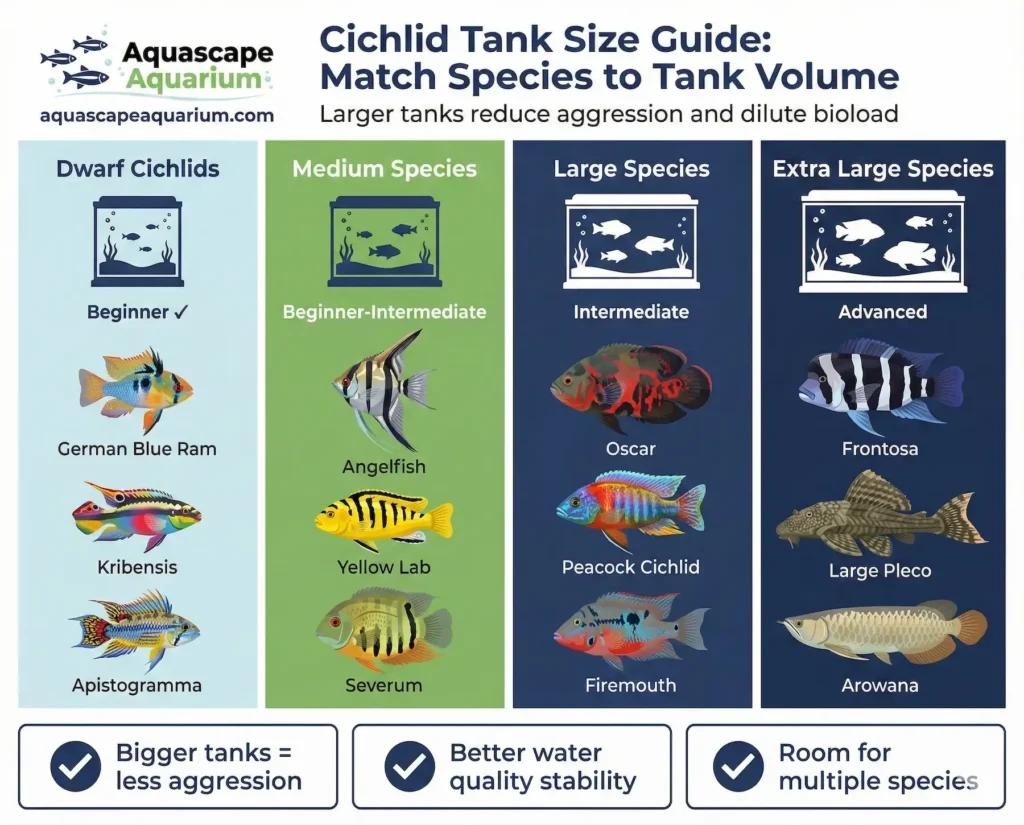
Most cichlids need larger tanks than beginner-level setups provide. Dwarf species work in 20-30 gallons, but most popular species need 55+ gallons. Large species like Oscars demand 75-125 gallons. Tank size isn’t just about room to swim-it’s about diluting aggression, managing bioload, and maintaining stable water chemistry.
Filtration Demands
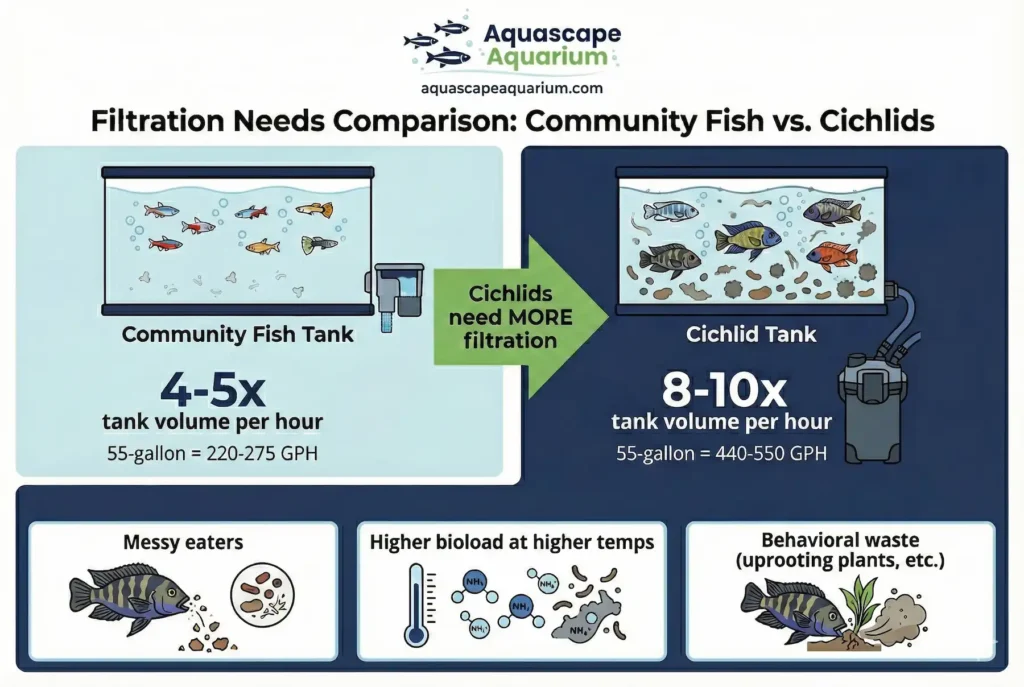
Cichlids are messy eaters and produce significant waste. You need filtration that turns over the tank volume 8-10 times per hour-roughly double what peaceful community fish require. This means investing in a quality canister filter from day one, not upgrading later.
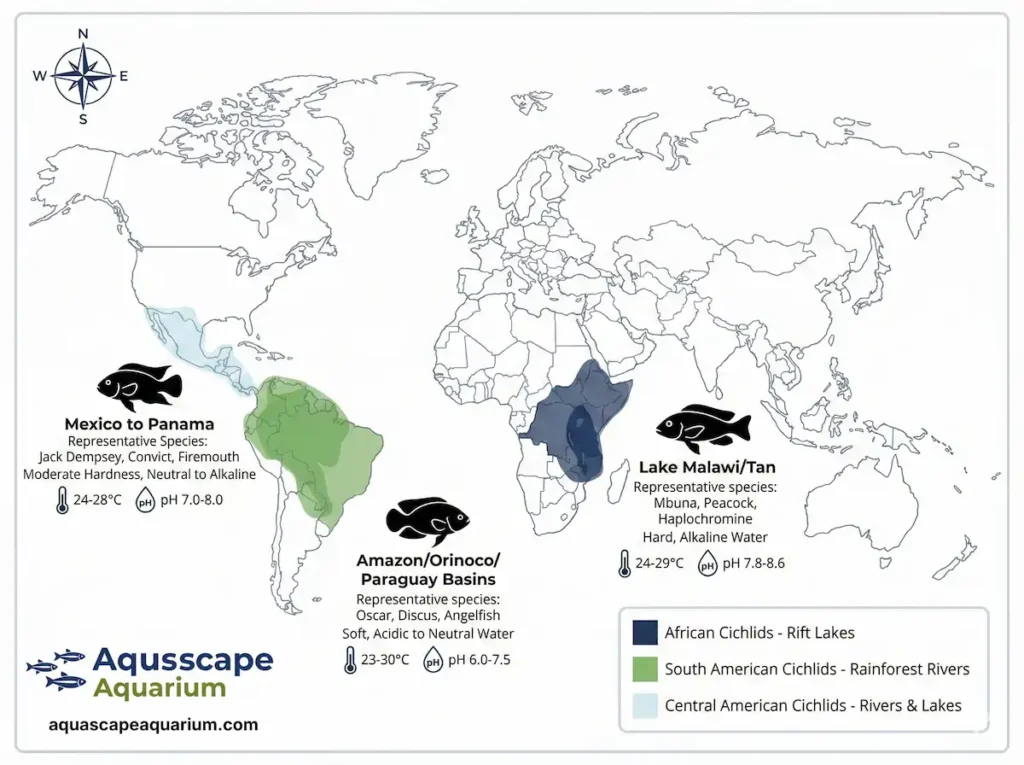
Cichlids evolved separately on three continents, resulting in dramatically different water chemistry needs, temperaments, and care requirements. Choosing the wrong type for your tap water is the #1 beginner mistake.
African Cichlids: Rift Lake Specialists
Lake Malawi (Most Popular)
- Species: Yellow Labs, Red Zebras, Peacocks
- pH: 7.8-8.6 (hard, alkaline water)
- Temperature: 76-82°F
- Tank Size: 55 gallons minimum for colonies
- Why Beginners Love Them: Very hardy once established and forgiving of minor mistakes. Yellow Labs tolerate parameter swings and breed readily without intervention.
Lake Tanganyika (Specialized)
- Species: Shell-dwellers, Frontosa
- pH: 7.8-8.6 (hard, alkaline; some sources suggest up to 9.0)
- Temperature: 75-80°F
- Tank Size: 20-125 gallons depending on species
- Complexity: Less aggressive than Malawi but more sensitive to water quality.
South American Cichlids: Planted Tank Specialists
Dwarf Cichlids (Good Option for Beginners with Soft Water)
- Species: German Blue Ram, Bolivian Ram, Apistogramma
- pH: 6.0-7.0 (soft, slightly acidic)
- Temperature: 78-84°F
- Tank Size: 20 gallons for a pair
- Good For: Planted tanks. Unlike Africans that uproot plants, these species generally leave vegetation alone and tolerate peaceful tank mates.
Medium South Americans
- Species: Angelfish, Discus, Severum
- pH: 6.0-7.5
- Temperature: Angels 76-82°F; Discus 82-86°F
- Tank Size: 55-125 gallons
- Note: Discus are advanced (require near-perfect water quality). Angels are beginner-friendly alternatives.
Large South Americans
- Species: Oscar, Green Terror, Jack Dempsey
- pH: 6.5-7.5
- Temperature: 74-80°F
- Tank Size: 75-125+ gallons
- Oscar Special: The cichlid world’s golden retriever-recognize owners, beg for food. But massive bioload and eat anything that fits in their mouths.
Central American Cichlids: The Hardy Options
- Species: Convict, Firemouth, Texas Cichlid
- pH: 7.0-8.0 (adaptable to most tap water)
- Temperature: 74-80°F
- Tank Size: 30-75 gallons
- Why They’re Popular: Hardy once established and forgiving of minor mistakes. Convicts breed readily in suitable conditions, often every 4-6 weeks, making them good for hobbyists interested in breeding.
Tank Requirements for Cichlids
Minimum Tank Sizes
| Type | Species | Minimum | Ideal |
|---|---|---|---|
| Dwarf | German Blue Ram | 20 gal | 30-40 gal |
| Medium African | Yellow Lab, Peacock | 55 gal | 75 gal |
| Medium S. American | Angelfish, Severum | 55 gal | 75-90 gal |
| Large | Oscar, Frontosa | 75 gal | 125+ gal |
Tank shape matters: Long tanks beat tall tanks for territorial species. A 55-gallon long (48″ × 13″) provides more territory than a 55-gallon tall.
Substrate Selection
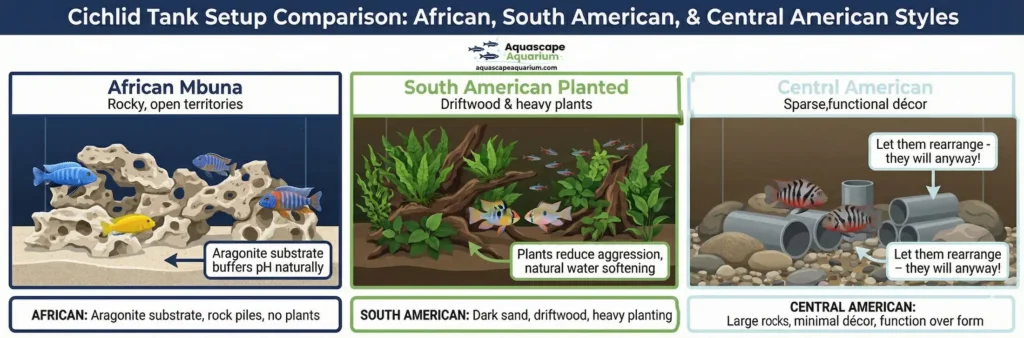
For African Cichlids:
- Aragonite Sand (Best): Naturally buffers pH to 8.0-8.4. Use 1-2 lbs per gallon.
- Crushed Coral: Works mixed 50/50 with aragonite.
- CaribSea Aragonite Reef Sand recommended (excellent buffering, natural color).
For South American Cichlids:
- Pool Filter Sand (Budget): Inert, doesn’t affect pH. Ultra-cheap ($8 for 50 lbs).
- Fluval Plant Stratum (Planted tanks): Lowers pH naturally to 6.0-6.5, supports plants.
- Avoid Aragonite: Will raise pH and hardness-opposite of what South Americans need.
For Central Americans:
- Most flexible. Inert gravel or light aragonite both work.
Aquascaping Strategy
African Cichlids:
- Create 2-3 rock piles using Texas Holey Rock or Lace Rock.
- More caves = less fighting over territories.
- Secure heavy rocks directly on tank bottom (prevent collapse).
South American Cichlids:
- Use Malaysian Driftwood + Java Fern + Anubias (hardy plants cichlids won’t uproot).
- Plant heavily along back and sides; leave open swimming space in front.
- Broken sight lines reduce fighting.
Central Americans:
- Skip expensive decor (they rearrange everything).
- Use large river rocks + PVC pipes as caves.
Essential Filtration
Cichlid Filtration Rule: Filter must turn over total tank volume 8-10 times per hour. For 75 gallons = 600-750 GPH needed.
Why? Cichlids produce 2-3x more ammonia than tetras. They’re messy eaters. Higher temperatures (78-84°F) = faster bacterial metabolism.
Recommended Canister Filters for Cichlids:
Fluval FX4: 700 GPH flow rate, handles 55-100 gallon tanks effectively. Quiet operation and good value across experience levels.
Fluval FX6: 925 GPH flow rate, suitable for heavily stocked 100-200 gallon systems. A popular choice among serious cichlid keepers.
Fluval 407: 383 GPH flow rate, good option for 40-70 gallon tanks and smaller setups.
Eheim Classic 2217: German-built with a strong reputation for durability. Many keepers report 20+ years of reliable service with basic maintenance.
Pro Tip: Run HOB filter + canister combo for redundancy. If canister fails during vacation, HOB keeps cycle alive.
Heating & Temperature Control
Heater Wattage Formula: 3-5 watts per gallon
- 55-gallon in 70°F room = 165-275W (use 200W)
- 75-gallon in 65°F basement = 225-375W (use 300W or two 150W)
Temperature Ranges:
- African Malawi/Tanganyika: 76-80°F
- South American Rams: 78-84°F
- South American Angels: 76-82°F
- Discus: 82-86°F
- Central American: 74-80°F
- Oscars: 74-81°F
Best Heater: Eheim Jager TruTemp ($25-$60). German-made, lasts 5-10 years. TruTemp dial lets you recalibrate if readings drift.
Pro Tip: Use TWO smaller heaters (2x 150W) instead of one large (300W) in 75+ gallon tanks. If one fails “on,” it can’t cook the tank.
Water Chemistry: The Foundation of Success
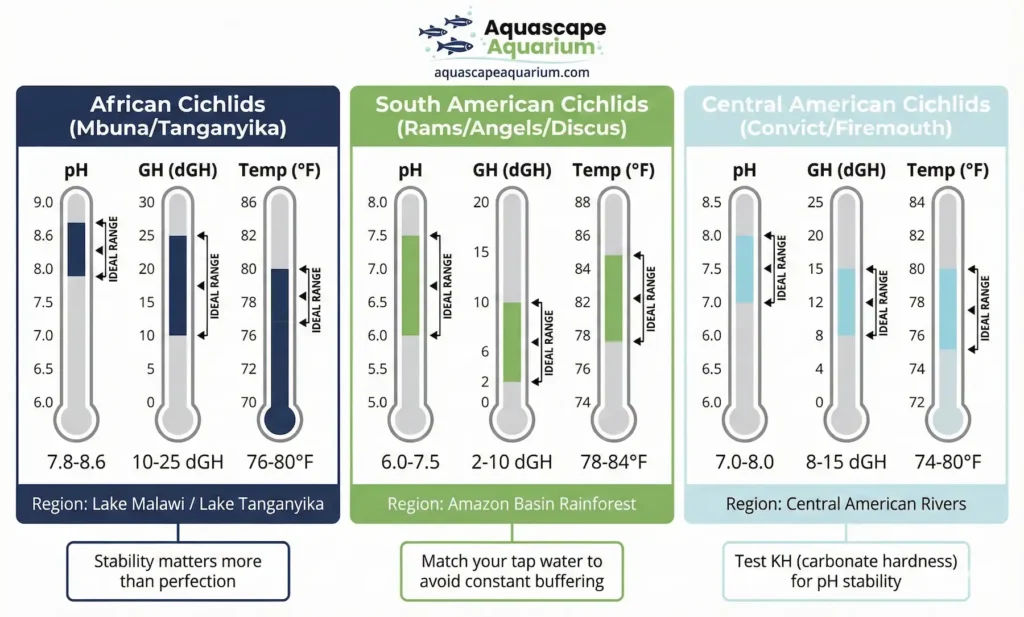
Lake Malawi cichlids typically struggle long-term in very soft, acidic water, and discus usually do poorly in hard, alkaline setups. Matching species to your tap water parameters gives you a much higher chance of success. Stability in water chemistry matters more than hitting perfect numbers-fish adapt to consistent conditions better than they adapt to constant fluctuation.
Target Parameters
African Cichlids (Malawi/Tanganyika/Victoria):
- pH: 7.8-8.6
- GH: 10-25 dGH
- KH: 10-20 dKH
- Temperature: 76-80°F
South American Cichlids (Rams/Angels/Discus):
- pH: 6.0-7.5 (Discus: 6.0-6.5)
- GH: 2-10 dGH (Discus: 1-6)
- KH: 2-8 dKH
- Temperature: 78-84°F (Discus: 82-86°F)
Central American Cichlids:
- pH: 7.0-8.0
- GH: 8-15 dGH
- KH: 6-12 dKH
- Temperature: 74-80°F
Achieving Target Parameters
If you have hard tap water (pH 7.5+, GH 10+): Well-suited to African cichlids. Use aragonite substrate and appropriate décor, and parameter maintenance becomes much easier.
If you have soft tap water (pH 6.5-7.5, GH <10): Well-suited to South Americans. Use inert sand plus driftwood, which naturally lowers pH over time.
If you have extremely hard water (pH 8.5+): Dilute with RO water. Don’t try to fight your tap water chemistry.
Testing & Maintenance
During Cycling (Weeks 1-6):
- Test daily: Ammonia, nitrite, nitrate
- Test pH every 3 days
Established Tanks:
- Test weekly: Nitrate (keep <40 ppm)
- Test monthly: pH, GH, KH
- Test immediately if fish show stress
Best Test Kit: API Freshwater Master Kit. Liquid tests provide 800+ tests per kit. Far more accurate than test strips and industry-standard for hobbyists.
Common Water Chemistry Mistakes
- Chasing perfect pH daily → Stability beats perfection. Never swing pH >0.2 per day.
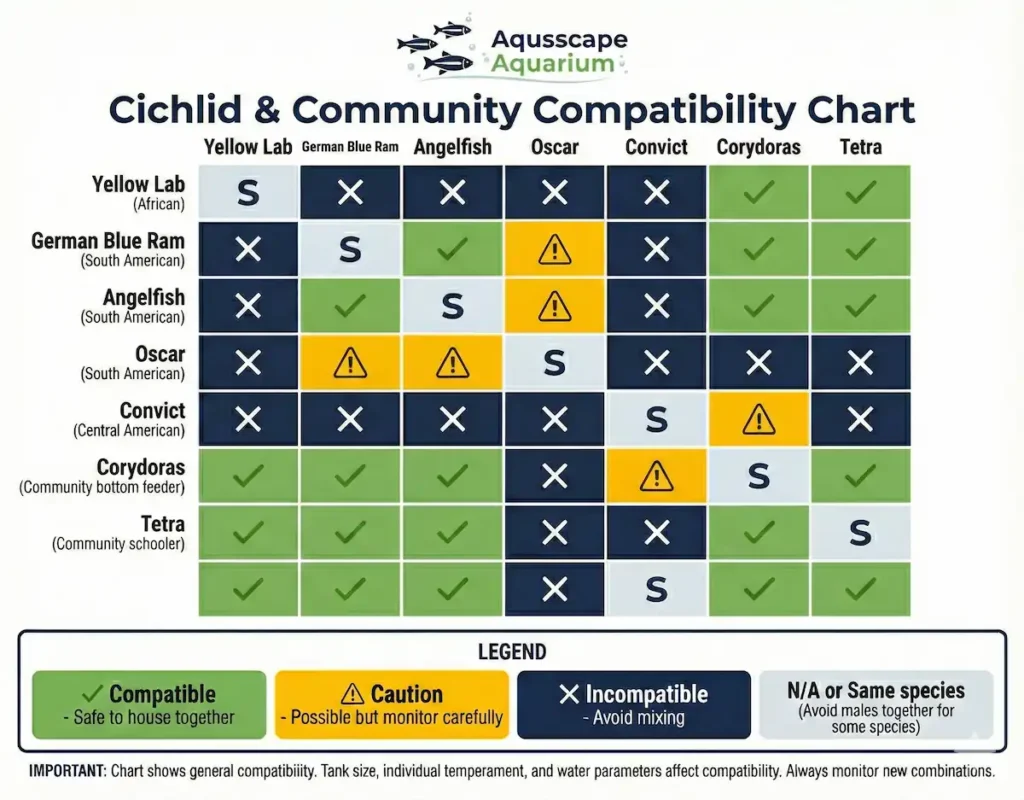
- Mixing African + South American → Different water needs. One group is usually compromised.
- Ignoring KH (carbonate hardness) → KH buffers pH. If KH drops below 4, pH crashes overnight.
- Massive water changes with different parameters → Never change >50% at once. Test tap water before changes.
- Using water softener → Replaces calcium/magnesium with sodium. Cichlids can’t process high sodium.
Diet & Nutrition
Different cichlid species evolved specialized digestive systems. Feed the wrong diet and you’ll see faded colors, bloat, aggression, and shortened lifespans.
Protein Requirements by Type
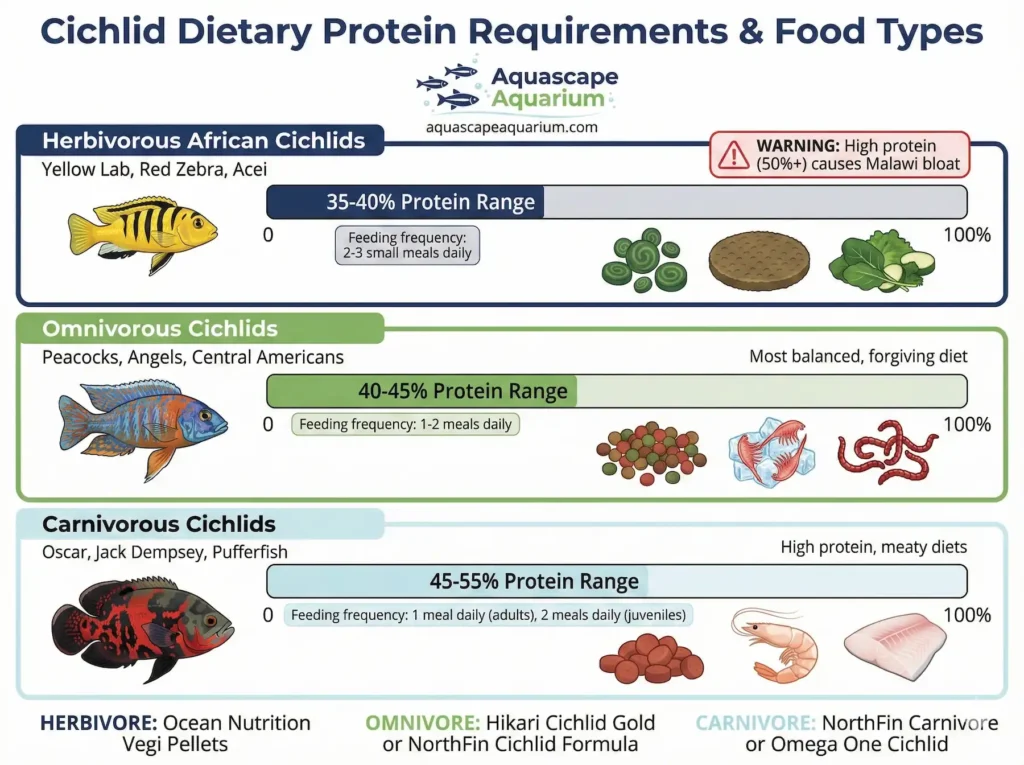
Herbivorous African Cichlids (Mbuna): 35-40% protein
- Primary: Spirulina, algae, vegetable matter
- Feeding: 2-3 small meals daily
- Warning: High protein (50%+) causes fatal Malawi bloat
Omnivorous Cichlids (Peacocks, Angels, Central Americans): 40-45% protein
- Primary: Mixed pellets + frozen foods
- Feeding: 1-2 meals daily
Carnivorous Cichlids (Oscars, Jack Dempseys): 45-55% protein
- Primary: Carnivore pellets, shrimp, fish, worms
- Feeding: 1 meal daily (adults); 2 meals daily (juveniles)
Best Foods by Category
High-Protein Pellets:
- NorthFin Cichlid Formula: 45% protein, no fillers. A popular choice among hobbyists keeping omnivores and carnivores. Mid-range pricing.
- Hikari Cichlid Gold: Many keepers report visible color enhancement within 2-4 weeks. Floating pellets encourage surface feeding. Mid-range pricing.
- Ocean Nutrition Cichlid: A balanced, affordable option that works well for multi-species tanks. Budget-friendly.
Herbivore Pellets (Mbuna):
- Ocean Nutrition Vegi Pellets: Formulated for herbivorous Africans with moderate protein to help prevent bloat. Budget-friendly.
- NorthFin Veggie Formula: A premium option with organic kelp and spirulina. Mid-range to premium pricing.
Frozen Foods (2-3x weekly):
- Bloodworms (high protein)
- Brine Shrimp (growth/color)
- Mysis Shrimp (excellent for large cichlids)
- Spirulina Brine Shrimp (for herbivores)
Feeding Tips:
- Feed what they consume in 2-3 minutes
- Remove uneaten food after 5 minutes
- One fasting day per week for adults (prevents obesity)
- Aim for 70% pellets, 30% frozen/live
Food-Related Health Problems
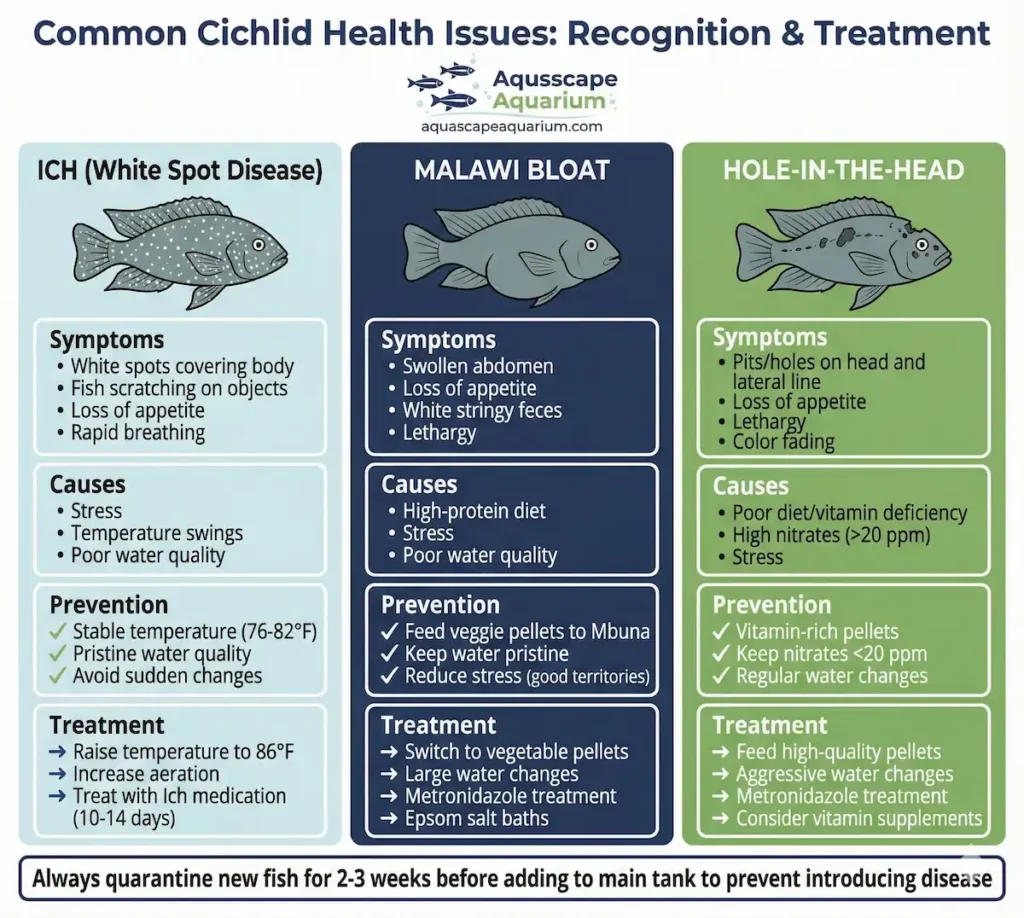
Malawi Bloat (African Cichlids):
- Cause: High-protein diet combined with stress and poor water quality
- Symptoms: Swollen abdomen, loss of appetite, white stringy feces
- Prevention: Feed vegetable-based pellets to Mbuna species only. Maintain pristine water quality and stable conditions.
- Treatment: Many hobbyists use metronidazole-based treatments (available at aquarium retailers) and Epsom salt baths according to product directions. When in doubt, consult an aquatic veterinarian or experienced cichlid keeper.
Tank Mate Compatibility
General Principles
- Generally avoid mixing continents → African and South American cichlids have divergent water chemistry preferences and aggression patterns, so one group is typically compromised in the same tank.
- Size matters → Cichlids will eat fish that fit in their mouths. Keep tank mates within a reasonable size range.
- Match aggression levels → Pairing peaceful species (Rams) with aggressive species (Jack Dempsey) means the peaceful fish hides and suffers.
- Overstocking can help → Counter-intuitive but effective: 20 Mbuna in 55 gallons exhibits less total aggression than 8 Mbuna, because no single fish can dominate everyone.
- Territory matters → Every cichlid benefits from having a safe zone (cave, rock cluster, plant thicket) to retreat into.
Sex-Specific Behaviors
Male-Dominant Aggression (Most Species):
- Males more aggressive than females
- Males establish territories fiercely
- Examples: Oscars, Peacocks, Haps, Jack Dempseys
Female-Dominant Aggression (Convicts):
- Female Convicts MORE aggressive than males during breeding
- Females attack anything-including males-threatening brood
- Convict females can show intense territorial behavior during breeding
Mouthbrooding Female Stress (African Cichlids):
- Females holding eggs become extremely stressed if harassed
- Can “stress-spit” eggs, losing entire spawn
- All-male African tanks eliminate this chaos
- All-male tanks = better color, no breeding harassment
Compatibility by Type
African Mbuna (55-Gallon):
- Stock 18-22 fish total
- 5-6 different species
- All-male or 3 females : 1 male ratio
- Example: 4 Yellow Labs, 4 Red Zebras, 3 Acei, 4 Rusty Cichlids, 3 Demasoni
South American Community (55-Gallon Planted):
- 1 pair German Blue Rams
- 6-8 Corydoras (bottom)
- 15-20 Tetras (mid-water)
- 6-8 Hatchetfish (top)
Oscar Tank (125-Gallon):
- 1-2 Oscars
- 1 Sailfin Pleco (too large to eat)
- 1 Jack Dempsey or Firemouth
- Avoid: Small fish (eaten), long-finned fish (fins shredded)
Dither Fish Strategy:
Fast schooling fish (Giant Danios, Rainbowfish, Silver Dollars) reduce cichlid aggression. School activity signals “no predators nearby.” Use 10-15 minimum.
Cichlid Breeding: Overview & Getting Started
Cichlid breeding is where many hobbyists deepen their commitment to the hobby. Unlike community fish that scatter eggs and abandon them, cichlids show parental care-and you can observe it.
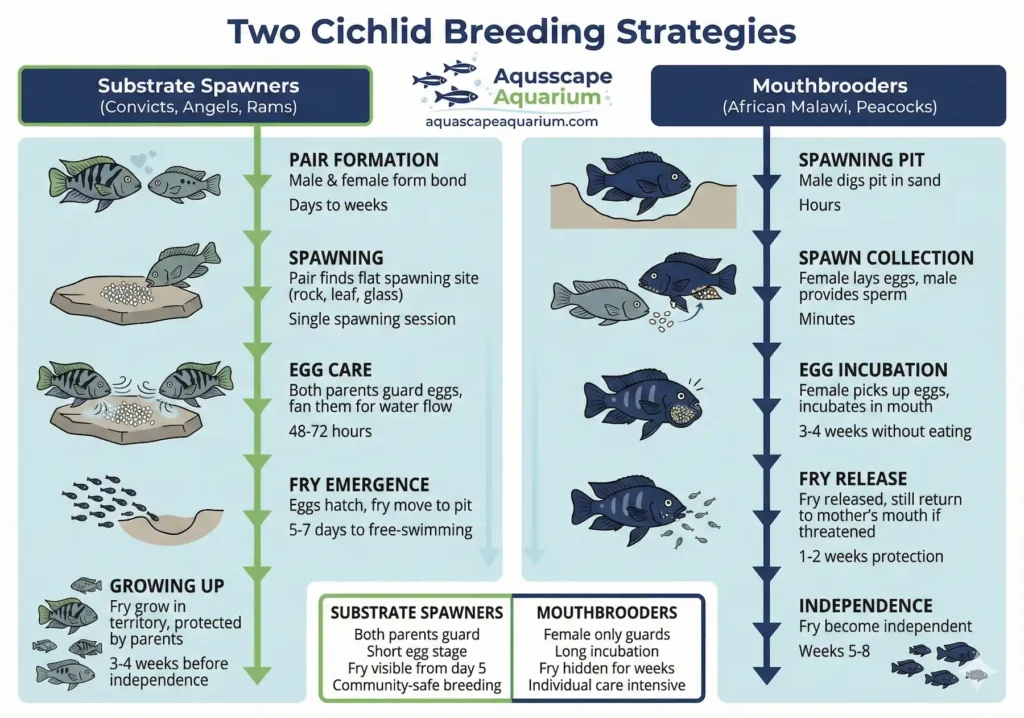
Breeding Methods
Substrate Spawners (Convicts, Angels, Rams, most South Americans)
- Pairs claim territory and clean a flat surface (rock, plant leaf, or tank wall)
- Female lays eggs; male fertilizes
- Both parents fan eggs and guard fry for several weeks
- Eggs hatch in 48-72 hours; fry become free-swimming in 5-7 days
Mouthbrooders (African Malawi Peacocks, Haps, some Tangs)
- Male digs breeding pit in sand
- Female lays eggs; male provides sperm (via “dummy egg” display)
- Female picks up eggs in her mouth and incubates for 3-4 weeks without eating
- Fry are protected in mother’s mouth for another 1-2 weeks after release
Basic Breeding Triggers
- Large (40-50%) water changes with slightly cooler water (mimics rainy season)
- Temperature manipulation (raise 2-4°F for one week, then return to normal)
- High-protein diet conditioning (frozen bloodworms, brine shrimp) for 2-3 weeks
- Extended photoperiod (increase lighting by 1-2 hours daily)
Fry Care Basics
- First foods: Freshly hatched baby brine shrimp or specialized fry powder
- Growth foods: Microworms, crushed pellets, small frozen foods
- Juvenile foods: Small pellets and occasional frozen treats
- Daily water changes (25-50%) to dilute growth-inhibiting hormones
For detailed breeding techniques, see the species-specific guides (Convict Cichlid Breeding, Breeding Angelfish, etc.).
Common Problems & Quick Fixes
Excessive Aggression
If one fish hides constantly: Add more hiding spots (caves, rock clusters, plants) to break up territories and give the subordinate fish safe zones.
If one fish bullies everyone else: Rearrange tank décor to reset territories (everyone starts equal), or remove the aggressor to a separate tank for 48 hours before reintroducing. Sometimes this resets dominance hierarchies.
If aggression escalates after breeding: Breeding pairs become hyper-territorial. Either remove the pair to a separate breeding tank, or add more fish to spread the aggression thin across more interactions.
Water Quality Emergencies
Ammonia or nitrite spike after adding fish: Slow your stocking. Beneficial bacteria lag behind bioload. Do 25% water changes every 2-3 days until readings return to 0 ppm.
pH crashes overnight despite substrate buffering: Check your KH (carbonate hardness). If KH drops below 4 dGH, pH becomes unstable. Add cichlid buffer if needed to raise KH back to 6-10 dGH.
Frequent cloudy water despite filter: Bioload is too high. Increase water change frequency (from weekly 25% to twice-weekly 25%), reduce feeding, or reduce stocking density.
Disease & Health
White spots (Ich): Raise temperature to 86°F, increase aeration, and treat with Ich medication per product directions. Treat for 10-14 days even after spots disappear.
Swollen abdomen with loss of appetite (Malawi bloat): Common in Mbuna fed high-protein diets. Switch to vegetable-based pellets immediately, do large water changes, and consider metronidazole treatment per product directions.
Small pits on head and lateral line (Hole-in-the-Head): Often linked to poor diet and high nitrates. Feed vitamin-rich pellets, ensure nitrates stay below 20 ppm, and consider metronidazole treatment.
Month 1: Planning, Setup & Cycling
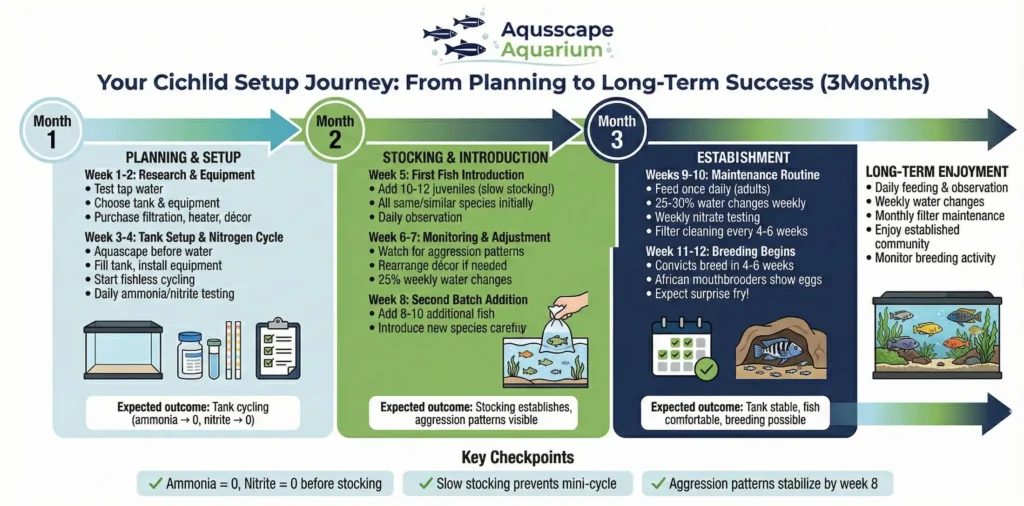
Week 1-2: Research & Equipment
- Determine cichlid type based on tap water (test first!)
- Purchase tank (55-75 gal), canister filter, heater (x2), substrate, décor
- Test kit (API Master + GH/KH kit)
Week 2: Tank Setup
- Rinse substrate thoroughly (30+ min until water runs clear)
- Aquascape before adding water
- Install equipment, fill with dechlorinated water
- Run 24 hours to check for leaks
Week 3-4: Nitrogen Cycle (Critical-don’t skip)
Fishless cycling (recommended): Add ammonia to 2-4 ppm → test daily → cycle complete when ammonia and nitrite both read 0 ppm after 24 hours (takes 4-6 weeks)
Month 2: Stocking
Week 5: Add first batch (10-12 fish, all juveniles, 3-4 species)
Week 6-7: Monitor daily for aggression. Rearrange décor if needed. 25% weekly water change.
Week 8: Add second batch (8-10 more fish)
Month 3: Maintenance & Enjoyment
Routine:
- Feed once daily (adults) or twice daily (juveniles)
- 25-30% water change weekly
- Test nitrates weekly
- Clean filter every 4-6 weeks
Expect Breeding:
- Convicts breed within 4-6 weeks
- Africans hold eggs by week 8-10
- Don’t panic-fry are normal and exciting!
Quick Start Tank Packages
SETUP 1: African Mbuna Tank (55-Gallon)
What You Need
Tank & Stand
- Aqueon 55-Gallon Standard Glass Aquarium (48″ × 13″ × 21″)
- Cost: $150-180
Filtration
- Fluval FX4 Canister Filter (700 GPH)
- Cost: $200-250
- Why: 700 GPH = 12.7x tank volume. Handles bioload of 20+ Mbuna.
Heating (Buy 2 for redundancy)
- 2× Eheim Jager 150W TruTemp Heater
- Cost: $60-100 total
- Target: 76-80°F
- Why: If one fails, the other maintains temperature
Substrate (Need 60-80 lbs)
- CaribSea Aragonite Aquarium Sand (20 lb bags, buy 3-4)
- Cost: $75-140 total
- Why: Buffers pH naturally to 7.8-8.4. Pre-cleaned. No maintenance.
Rockwork & Décor
- Texas Holey Rock or limestone rocks (30-40 lbs)
- Cost: $20-40
- Why: Create 5-6 caves for territories. Reduces aggression.
Lighting
- LED Aquarium Hood or adjustable LED
- Cost: $50-100
Test Kit
- API Master Freshwater Test Kit + GH/KH Kit
- Cost: $55-70
- Why: Liquid tests (800+ tests). Far more accurate than strips.
Food
- Hikari Cichlid Gold (color enhancement): $12-18
- Ocean Nutrition Spirulina (for herbivorous Mbuna): $12-18
- Why: Herbivorous Mbuna need 35-40% protein (prevents bloat)
Total Equipment Cost: $610-755
Monthly Costs
- Food: $15-25
- Electricity: $10-15
- Filter media: $10-15
- Monthly Total: $35-55
Fish Stocking (20-22 fish)
- 4× Yellow Lab Cichlids ($12-20)
- 4× Red Zebra Cichlids ($12-20)
- 3× Acei Cichlids ($12-18)
- 4× Rusty Cichlids ($8-16)
- 3× Demasoni Cichlids ($9-15)
- Fish Total: $53-89
Why This Works
- Aragonite substrate buffers pH automatically (no daily adjustments)
- FX4 filter handles 20+ fish bioload effortlessly
- Dual heaters prevent temperature crashes if one fails
- Hardy Mbuna forgive beginner mistakes with parameters
- Rock décor creates natural territories (less fighting)
- All-male colonies reduce breeding chaos
3-Month Timeline
- Weeks 1-4: Setup, aquascape, nitrogen cycle begins
- Week 5: Add first 10-12 fish slowly
- Weeks 6-7: Monitor aggression, rearrange décor if needed
- Week 8: Add remaining 8-10 fish
- Weeks 9-12: Maintenance routine established, breeding visible
Weekly Maintenance
- Water change: 25-30%
- Test nitrate (keep under 40 ppm)
- Feed once daily (juveniles twice)
- 5-minute observation for health/aggression
SETUP 2: South American Planted Tank (55-60 Gallon)
What You Need
Tank & Stand
- Fluval Roma 90 LED Aquarium (47″ × 20″ × 20″, ~60 gallons)
- Cost: $300-400
- Why: High-clarity glass, built-in LED lighting, premium aesthetics
Filtration
- Fluval 307 Canister Filter (600 GPH)
- Cost: $150-200
- Why: Gentle flow preserves plants, handles 8-12 fish without disruption
Heating (Buy 2 for redundancy)
- 2× Eheim Jager 150W TruTemp Heater
- Cost: $60-100 total
- Target: 78-82°F
- Why: South Americans need warmer temps. Dual setup provides backup.
Substrate (Need 60-80 lbs)
- Fluval Plant Stratum (8.8 lb bags, buy 7-9)
- Cost: $245-405 total
- Why: Lowers pH naturally to 6.0-6.5 (perfect for South Americans). Contains plant nutrients.
Plants & Décor
- Malaysian Driftwood: $15-30
- Java Fern: $10-15
- Anubias: $10-15
- Sword Plants: $8-12
- Total: $50-75
Lighting
- Included with Fluval Roma LED kit
Test Kit
- API Master Freshwater Test Kit + GH/KH Kit
- Cost: $55-70
- Why: Monitor pH stability (should be 6.0-7.5). GH/KH confirms water is soft enough.
Food
- NorthFin Cichlid Formula (premium): $30-40
- Why: Best ingredients, no fillers. Supports health in pristine soft water.
Total Equipment Cost: $915-1,155
Monthly Costs
- Food: $20-30
- Electricity: $12-18
- Filter media: $10-15
- Plant fertilizers: $10-15
- Monthly Total: $52-78
Fish Stocking (8-12 fish)
- 1× Angelfish Pair: $8-15
- 1× German Blue Ram Pair: $8-12
- 6-8× Corydoras Catfish: $18-32
- 15-20× Neon or Cardinal Tetras: $7.50-20
- Optional: 1× Bristlenose Pleco: $5-10
Why This Works
- Planted tank reduces cichlid aggression naturally (fish feel safer)
- Plant Stratum softens water naturally (no chemical buffers needed)
- Peaceful species-only setup (no hierarchy battles or predation)
- Plants consume nitrates (self-sustaining ecosystem, healthier water)
- Beautiful long-term display (high-end aesthetic appeal)
- Angels breed readily in proper planted setup
3-Month Timeline
- Weeks 1-4: Tank setup, plant anchoring, nitrogen cycle
- Week 5: Add 4-6 foundation fish (Corydoras, Tetras, one Ram pair)
- Weeks 6-7: Monitor plant growth, add fertilizers, check pH stability
- Week 8: Add Angelfish pair (establish as main residents)
- Weeks 9-12: Established planted community, expect Angel breeding behavior
Weekly Maintenance
- Water change: 25-30% (essential for soft water stability)
- Test pH (should be 6.5-7.0 and stable)
- Prune fast-growing plants
- Feed once daily
SETUP 3: Central American Cichlid Tank (55-Gallon)
What You Need
Tank & Stand
- Aqueon 55-Gallon Standard Glass Aquarium (48″ × 13″ × 21″)
- Cost: $150-180
- Why: Simple, reliable. Central Americans will rearrange décor anyway, so invest in equipment.
Filtration
- Fluval 307 Canister Filter (600 GPH)
- Cost: $150-200
- Why: Handles bioload well. More affordable than FX4. Proven reliability.
Heating (Buy 2 for redundancy)
- 2× Eheim Jager 150W TruTemp Heater
- Cost: $60-100 total
- Target: 74-80°F
- Why: Central Americans need slightly cooler temps. Dual setup = backup.
Substrate (Need 60-80 lbs)
- Pool Filter Sand (50 lb bags, buy 2)
- Cost: $30-50 total
- Why: Ultra-budget option. Inert (doesn’t affect pH). Requires heavy rinsing but works great.
Rockwork & Décor
- Large River Rocks: $15-25
- PVC Pipes (4″ diameter as caves): $10-15
- Minimal philosophy: Let them rearrange it themselves
- Total: $25-40
Lighting
- Basic LED Hood
- Cost: $40-80
Test Kit
- API Master Freshwater Test Kit
- Cost: $30-35
- Why: Central Americans are adaptable. Basic ammonia/nitrite/nitrate/pH testing sufficient.
Food
- Omega One Cichlid Pellet (budget quality): $10-15
- Frozen foods (bloodworms, brine shrimp for conditioning): $10-15
- Why: Central Americans less picky about food. Budget pellets work fine.
Total Equipment Cost: $495-560
Monthly Costs
- Food: $15-20
- Electricity: $8-12
- Filter media: $8-10
- Monthly Total: $31-42
Fish Stocking (6-8 fish)
- 1× Convict Cichlid Pair: $5-8
- 1× Firemouth Cichlid Pair: $8-12
- Optional: 1× Jack Dempsey: $8-12
- Optional: 6× Corydoras: $18-24
Breeding Note: Convicts breed every 4-6 weeks. Be prepared to move fry to separate tank or sell to local aquarium stores.
Why This Works
- Minimal setup = maximum breeding activity (most entertainment)
- Most affordable option throughout (lowest costs)
- Hardiest species (most forgiving of poor parameters)
- Most entertaining breeding and parental behavior to observe
- No plants to worry about (they destroy them anyway)
- Fish self-decorate through digging and rearranging
3-Month Timeline
- Weeks 1-4: Tank setup, basic aquascaping, nitrogen cycle
- Week 5: Add Convict pair + Firemouth pair
- Weeks 6-7: Pairs establish territory, monitor aggression carefully
- Week 8: First breeding activity visible (substrate cleaning, cave selection)
- Weeks 9-12: First fry appear, new eggs every 4-6 weeks
Weekly Maintenance
- Water change: 25-30% (important if fry present)
- Test nitrate (keep under 40 ppm)
- Feed once daily
- Watch for fry or breeding behavior
Quick Comparison
African Mbuna Setup
- Equipment cost: $610-755 startup
- Monthly cost: $35-55
- Fish count: 20-22 (colony)
- Water type: Hard, Alkaline (pH 7.8-8.6)
- Plants: None (destroyed)
- Tank setup: Rock-based territories
- Best for: Color display, hardy beginner setup, multiple species
South American Planted Setup
- Equipment cost: $915-1,155 startup
- Monthly cost: $52-78
- Fish count: 8-12 (peaceful)
- Water type: Soft, Acidic (pH 6.0-7.5)
- Plants: Heavy (required)
- Tank setup: Planted with driftwood
- Best for: Beautiful display, peaceful community, aesthetic appeal
Central American Setup
- Equipment cost: $495-560 startup
- Monthly cost: $31-42
- Fish count: 6-8 (aggressive pairs)
- Water type: Adaptable (pH 7.0-8.0)
- Plants: None (destroyed)
- Tank setup: Minimal rock/PVC décor
- Best for: Breeding observation, behavior watching, budget-conscious
How to Choose
Go with African Mbuna if you want:
- Colorful, active display with multiple species in one tank
- Hardy, beginner-friendly fish that forgive mistakes
- Budget-conscious equipment approach with reliable results
Go with South American Planted if you want:
- Beautiful planted aquascape aesthetic
- Peaceful community experience with no aggression
- Premium long-term investment for serious hobbyists
Go with Central American if you want:
- Easiest breeding project to observe and learn from
- Most entertaining parental behavior watching
- Cheapest overall option (startup + monthly)
- Hardiest fish available (most forgiving)
Before You Buy Anything
- Test your tap water – Take sample to local aquarium store for pH, GH, KH testing
- Match water chemistry to cichlid type – This is the #1 reason setups fail (African = hard/alkaline, South American = soft/acidic)
- Set up tank 4-6 weeks before adding fish – Don’t rush this step
- Complete nitrogen cycling – Ammonia and nitrite must both be 0 ppm before adding fish
- Have a fry plan – Breeding happens faster than you think (especially Convicts)
General Maintenance for All Setups
Daily
- Feed once (adults) or twice (juveniles)
- 5-minute observation for health/behavior/aggression
Weekly
- Water change 25-30%
- Test nitrate (should be under 40 ppm)
Monthly
- Clean filter media (rinse in old tank water, never replace with tap water)
- Test pH and temperature stability
- Check for signs of stress (hiding, color loss, clamped fins)
Quarterly
- Replace filter media if needed
- Deep clean décor and substrate
- Review stocking and aggression levels
Pro Tips for Success
Before cycling:
- Rinse substrate thoroughly (aragonite and sand both need rinsing)
- Test your water chemistry (you need to know your starting point)
- Make sure all equipment works before adding water
During cycling:
- Use API Ammonia or fish food to feed the cycle
- Test daily (boring but important)
- Don’t add fish until ammonia and nitrite are both 0
After adding fish:
- Do partial water changes more frequently first month (helps with mini-cycle)
- Watch daily for aggression patterns
- Be ready to rearrange décor if fighting becomes serious
Long-term:
- Keep backup heater on hand (they fail without warning)
- Keep spare filter media available (don’t wait until emergency)
- Document your setup (photos help troubleshooting)
- Join online aquarium communities (experienced keepers love helping)
FAQ
What is the best beginner cichlid?
African: Yellow Lab (forgiving of parameter swings, vibrant, hardy once established, breeds easily). South American: German Blue Ram (if soft water available). Central: Convict (very hardy once established, fascinating breeder).
What Tank size needed?
Dwarf: 30 gal minimum. African colonies: 55 gal minimum. Large species: 75+ gallons. Bigger is always better.
Can they live in community?
Only peaceful species (Rams, Apistos, Angels) in planted tanks with tetras/corydoras. Avoid mixing African and South American cichlids in the same tank, as their water chemistry needs diverge significantly. Never keep Oscars with small fish.
What do they eat?
Herbivorous Mbuna: 35-40% protein veggie pellets. Omnivores: 40-45% balanced pellets + frozen. Carnivores: 45-55% high-protein + meat.
Are they hard to keep?
Range from beginner-friendly (Convicts, Yellow Labs) to expert-only (Discus). Difficulty is matching water chemistry + managing aggression, not the fish itself.
How long do they live?
Small species: 3-5 years. Medium: 6-10 years. Large: 10-15 years. Lifespan depends on water quality, diet, stress.
Do they need heaters?
Yes, absolutely. All tropical cichlids need stable temps. Use 3-5 watts per gallon. Temperature swings trigger stress and disease.
Can I breed them?
Yes. Convicts breed readily in suitable conditions, often producing fry every 4-6 weeks. African mouthbrooders breed readily in colonies. The challenge isn’t triggering breeding-it’s managing overpopulation and finding homes for juveniles.
Final Thoughts: Your Cichlid Journey Starts Now
Cichlids aren’t just fish-they’re personalities with fins. They’ll recognize you, respond to your presence, and display behaviors that rival saltwater fish at a fraction of the cost. A well-maintained cichlid tank becomes a living ecosystem that rewards daily observation and dedicated care.
The path to cichlid success is straightforward: match species to your water parameters, provide adequate tank size and filtration, maintain stable water chemistry, and feed appropriate diets. Start with hardy species that match your tap water. Master the basics with forgiving species before tackling sensitive varieties like Discus. Build experience through mistakes and learning, then gradually expand into breeding or more challenging species.
Explore the Complete Cichlid Care Library
Species Guides:
- Yellow Lab Care Guide
- German Blue Ram Care
- Oscar Fish Complete Guide
- Angelfish Care & Breeding
- Convict Cichlid Breeding Guide
Setup & Equipment:
- African Cichlid Tank Setup
- Planted Tank for South American Cichlids
- Best Filters for Cichlid Tanks
Advanced Topics:
- Cichlid Breeding for Beginners
- Managing Cichlid Aggression
- Cichlid Disease Identification & Treatment
Whether you choose the electric colors of Lake Malawi, the graceful elegance of Angelfish, or the personable companionship of an Oscar, you’re entering a hobby that can last a lifetime. Cichlid keepers become devoted to this family because these fish give back what you invest-attention, intelligence, breeding displays, and genuine connection.
Your cichlid journey starts now. Test your water. Choose your species. Build your tank. Prepare for one of the most rewarding experiences in aquarium keeping.